 (2).jpg)
 16 hours ago
3
16 hours ago
3
Interim summary
In case you’re just joining us, here’s a quick recap of the latest as the Middle East crisis escalates once again. It’s 9.30am in Tehran and 2am in Washington DC.
-
The US carried out a third consecutive night of strikes against Iran on Monday and two tankers came under fire in the strait of Hormuz.
-
Donald Trump said the US would reinstate its blockade of Iranian shipping in the Gulf. It would begin at 4pm ET on Tuesday, US Central Command said.
-
Trump said the Hormuz strait would stay open “with or without Iran” but that the US would start charging fees on ships transiting through the waterway, in an apparent policy reversal. A 20% fee would be levied “for any and all costs necessary” to provide security and safety for vessels, the president said.
-
Iran’s top joint military command said the US had no role in determining the strait’s future and would not be allowed to intervene. Foreign minister Abbas Araqchi said Tehran would “forever” be the guardian of the strait.
-
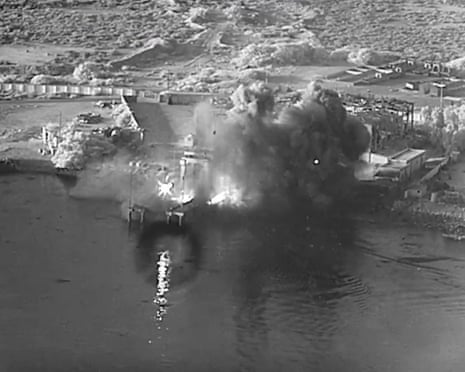
Iranian media reported explosions in the port city of Bandar Abbas, Iran’s Kish and Qeshm islands and on Abu Musa Island in the Gulf shortly after the US military announced the renewed strikes on Iran.
-
The United Arab Emirates said Iranian cruise missiles struck two Emirati oil tankers while transiting the southern lane of the vital energy transit route in Omani territorial waters, killing a crew member and injuring eight.
-
Oil prices roes 2% to their highest in four weeks amid heightened uncertainty about energy flows through the strait of Hormuz. Brent crude futures climbed 2% to $84.98 a barrel by 0051 GMT on Tuesday, while US West Texas Intermediate crude rose 2.1% to $79.79. Brent crude surged 9.6% in the previous session – its biggest daily gain since May 2020.
Key events
The Lebanese president, Joseph Aoun, has condemned the “hostile” Iranian attacks on Gulf countries (and Jordan) that he says are designed to keep the “entire region in a state of permanent tension and anxiety”.
In a statement published by the Lebanese presidency, Aoun pledged complete Lebanese solidarity – both officially and “popularly” - with Jordan, Saudi Arabia and all the Gulf states, whose security is an “integral” part of wider “Arab national security” and who share “deep historical” ties with Lebanon.
As a reminder, Yemen’s Iran-backed Houthis said they struck Saudi Arabia’s Abha international airport with ballistic missiles and drones in retaliation for a strike on Sanaa’s international airport.
Jordan, meanwhile, reportedly intercepted four missiles this morning, resulting in no casualties or “material damage”.
Over the last six hours, Bahrain’s interior ministry posted six times on social media urging residents to seek the nearest shelter as sirens were activated.
Earlier, Iran’s Islamic Revolutionary Guard Corps (IRGC) claimed that a patriot radar, the US Navy’s fifth fleet air control radar, and an early warning radar system were destroyed in an attack on the country.
We have not been able to independently verify these claims.
Interim summary
In case you’re just joining us, here’s a quick recap of the latest as the Middle East crisis escalates once again. It’s 9.30am in Tehran and 2am in Washington DC.
-
The US carried out a third consecutive night of strikes against Iran on Monday and two tankers came under fire in the strait of Hormuz.
-
Donald Trump said the US would reinstate its blockade of Iranian shipping in the Gulf. It would begin at 4pm ET on Tuesday, US Central Command said.
-
Trump said the Hormuz strait would stay open “with or without Iran” but that the US would start charging fees on ships transiting through the waterway, in an apparent policy reversal. A 20% fee would be levied “for any and all costs necessary” to provide security and safety for vessels, the president said.
-
Iran’s top joint military command said the US had no role in determining the strait’s future and would not be allowed to intervene. Foreign minister Abbas Araqchi said Tehran would “forever” be the guardian of the strait.
-
Iranian media reported explosions in the port city of Bandar Abbas, Iran’s Kish and Qeshm islands and on Abu Musa Island in the Gulf shortly after the US military announced the renewed strikes on Iran.
-
The United Arab Emirates said Iranian cruise missiles struck two Emirati oil tankers while transiting the southern lane of the vital energy transit route in Omani territorial waters, killing a crew member and injuring eight.
-
Oil prices roes 2% to their highest in four weeks amid heightened uncertainty about energy flows through the strait of Hormuz. Brent crude futures climbed 2% to $84.98 a barrel by 0051 GMT on Tuesday, while US West Texas Intermediate crude rose 2.1% to $79.79. Brent crude surged 9.6% in the previous session – its biggest daily gain since May 2020.
Donald Trump’s announcement that the US will begin charging ships for safe passage through the strait of Hormuz is not only an about-face for his administration but upends hundreds of years of American policy supporting freedom of navigation around the world.
“We’re protecting a very rich portion of the world,” the president said. “We’re spending money. And so, what we’ve done is, we are going to be reimbursed for protection.”
It’s a shift in US policy that, until now, said the strait should remain open to all without tolls – as it was before the US and Israel attacked Iran on 28 February. But as the Associated Press reports, any attempt by the US or Iran to charge fees would violate global norms on freedom of navigation and raise tensions, likely causing further economic disruption far beyond the region.
The US navy has fought for freedom of navigation on the seas since the Barbary Wars and the War of 1812.
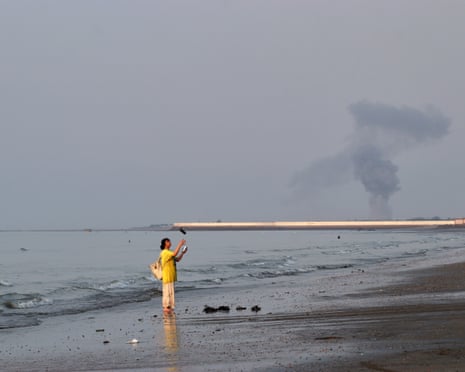
Trump said on Monday the US was “taking over” the Hormuz strait and would be paid for its operations.
“We’re going to keep the strait, and we’ll probably run it. We’ll become the guardian of the strait,” he told Fox News. Wealthy nations would have to reimburse the US.
We’re going to get paid for guarding it. A lot of money, but we just want to be reimbursed for doing all of this, for putting our people in danger.
Trump later said on Truth Social that the US would be reimbursed – at 20% of all cargo shipped – “for any and all costs necessary to do the job of providing safety and security”.
Iran’s military warned that it would not allow the US to “interfere” in the strait’s management.
'Clock ticking again' on global oil inventory depletion, economist warns

Luca Ittimani
Resurgent oil and fuel prices could cement a fourth interest rate rise in Australia this year if Donald Trump’s renewed conflict with Iran is not resolved within a week, economists warn.
US missile strikes on Iran and Trump’s announcement of a new maritime blockade has lifted oil prices to their highest point in the month since the two countries agreed to a peace deal.
Brent crude oil hit US$85 a barrel on Tuesday morning, while the West Texas Intermediate benchmark price for US crude surpassed US$80 a barrel. Both had been trading near US$70 in early July.
Escalating hostilities could run down oil stockpiles and push prices far above their April high, an energy commodities strategist at Australia’s Commonwealth Bank said in a note on Tuesday.
“The clock has started ticking again on global oil inventory depletion,” Vivek Dhar said.
Continued conflict would push Brent oil prices to $US100 a barrel within 10 days and $150 a barrel within 10 weeks, he said.
Iran rescued 23 foreign crew members after a bulk carrier collided with another vessel north of Qeshm Island in the strait of Hormuz, according to the Fars news agency.
The carrier suffered serious damage to its hull and began taking on water, prompting the captain to order an emergency evacuation, the semi-official Iranian agency said.
All crew members were safely transferred to Qeshm Island, it said, cited by Reuters.
Iran claims attack on US military base in Jordan
Iranian ballistic missiles targeted a US airbase in Jordan on Tuesday, Iran’s Revolutionary Guards said in a statement published by Fars News, calling on the Jordanian people to dismantle American bases in their country.
The statement, cited by Reuters, said:
You know very well that not only do we not have any enmity with your country, but we also love you, the noble people, who understand the pain and oppression of the Palestinian people more than any other nation.
As mentioned earlier, Jordan hosts a number of US forces and aircraft. On Monday, Tehran claimed it hit the country’s Prince Hassan airbase as part of its retaliatory strikes against the US, but Jordan denied the reports.
Bahrain has sounded its missile alert siren for the third time in about five hours as Iran continues its retaliation over American military strikes.
Bahrain’s interior ministry, posting on X, urged people to head to the nearest safe location.
Iran said on Monday it hit US military facilities and infrastructure in the country, while Bahrain’s military accused Tehran of targeting civilians in its “heinous attacks”.
A bit more now on the two Emirati tankers hit in the strait of Hormuz in the past few hours.
The United Arab Emirates’ defence ministry said early on Tuesday that the attack killed one mariner and wounded eight others. The ministry blamed Iran for the attack, saying it had launched two cruise missiles at the tankers Mombasa and Al Bahiyah.
The strikes set both tankers ablaze, though the fires were extinguished.
Iran’s Revolutionary Guards claimed the attack on the tankers, saying the vessels “ignored repeated warnings”.
“They chose to pass through a minefield and were subsequently targeted and disabled,” the Guards said.
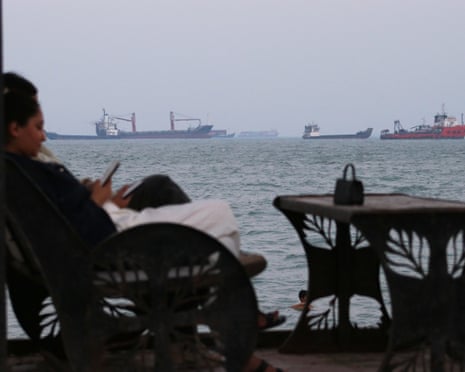
Jordan’s military says it intercepted four missiles launched by Iran.
Jordan hosts a number of US forces and aircraft.
On Monday, Iran claimed it had struck Prince Hassan airbase in Jordan as part of its retaliatory strikes against the US, but Jordan denied the reports were true.
Stocks have fallen and oil hit a one-month high in Asian trading on Tuesday after Donald Trump said the US was reinstating its blockade of Iranian shipping in the strait of Hormuz.
Shares in Taiwan and South Korea were particularly hard hit, while Japan’s Nikkei 225 fell 0.8%.
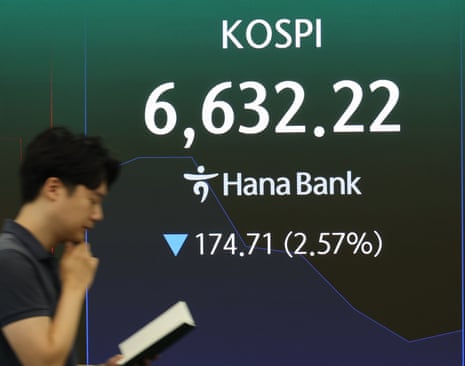
Brent crude futures climbed 1.7% to $84.72 a barrel, after earlier hitting their highest point since mid-June at $85.64. Markets were also rattled by comments on Monday from US federal reserve governor Christopher Waller, who said the central bank may need to raise interest rates “in the near term” if data shows inflation continuing well above the 2% target.
Iran responded to the latest US strikes with attacks targeting American bases in Bahrain. It marks the third day in a row that Iran retaliated against Gulf countries after US attacks on its facilities.
Early on Tuesday, Bahrain sounded its missile alert sirens twice, urging the public to seek shelter. There was no word on any damage or casualties from the attack.
Iran’s Revolutionary Guards claimed a US Patriot radar, a Fifth Fleet air control radar and other systems were all hit in Bahrain, but there was no independent confirmation.
US Central Command said a little over an hour ago that it had finished the military’s latest wave of strikes against Iran.
It said in a statement posted on X:
During the five-hour mission, U.S. forces successfully struck military targets across Iran including Bushehr, Chah Bahar, Jask, Konarak, Abu Musa, and Bandar Abbas to further degrade Iran’s ability to attack commercial shipping
Centcom said it targeted “Iranian coastal defense systems, missile and drone sites, and maritime capabilities”.
More than 50,000 US service members were currently deployed across the Middle East, it added.
US launches fresh strikes on Iran as tankers hit in Hormuz strait
Welcome to our continuing live coverage of the crisis in the Middle East.
The US carried out a third consecutive night of strikes against Iran on Monday and two tankers came under fire in the strait of Hormuz after Donald Trump said Washington was reinstating its blockade of Iranian shipping in the Gulf and would ensure that the strategic waterway stayed open, but for a fee.
US Central Command said it began strikes at the president’s direction just after he said Iran would be hit “very hard tonight and we’re going to hit them hard tomorrow”, later saying the US was attacking Iranian capabilities in the strait.
Soon after, the United Arab Emirates said Iranian cruise missiles struck two Emirati oil tankers while transiting the southern lane of the vital energy transit route in Omani territorial waters, killing one crew member and injuring eight.
With the US-Iran memorandum of understanding in a shambles after fighting reignited between them last week, Trump claimed the strait was open and would stay open “with or without Iran”. The president also announced the US would start charging fees on ships transiting through the waterway, claiming a 20% fee would be levied “for any and all costs necessary” to provide security and safety for vessels.
Iran’s top joint military command said the US had no role in determining the strait’s future and would not be allowed to intervene. Iranian foreign minister Abbas Araqchi said on X that Tehran would “forever” be the guardian of the strait, adding over Trump’s comments: “20% is of course too much. We will be fair.”
In other developments:
-
Iranian media reported explosions in the port city of Bandar Abbas, Iran’s Kish and Qeshm islands and on Abu Musa Island in the Gulf soon after the US military announced renewed strikes on Iran.
-
The US military started preparing to resume blockading ships heading to and exiting Iranian ports from 4pm ET on Tuesday, US Central Command said, after Trump’s announcement.
-
Oil prices roes 2% to their highest in four weeks amid heightened uncertainty about energy flows through the strait of Hormuz. Brent crude futures climbed 2% to $84.98 a barrel by 0051 GMT on Tuesday, while US West Texas Intermediate crude rose 2.1% to $79.79. Brent crude surged 9.6% in the previous session – its biggest daily gain since May 2020.
-
The International Maritime Organisation (IMO) said passage through the strait of Hormuz “should remain free of any tolls and charges, in accordance with international law”.
-
The Saudi-led coalition in Yemen said its air defences dealt with ballistic missiles launched by Yemen’s Iran-aligned Houthis towards the kingdom’s southern region, as tensions rose after Sana’a airport was attacked. The Houthis earlier said Saudi Arabia had launched strikes on the airport in the Yemeni capital. The Saudi-backed Yemeni government claimed responsibility for the attack, saying it wanted to prevent an Iranian plane from landing. The Houthis earlier warned the strikes would end an informal truce between the two sides that has held since 2022.

 English (US) ·