
 1 hour ago
1
1 hour ago
1
Last week, right at the start of this year’s holiday season, a 30-year-old drunk British holidaymaker tried to kiss a male flight attendant on a plane, spent a week in Mallorca presumably thinking his actions were consequence-free, and was then arrested on his way back through Palma airport. In February, Jet2 banned two passengers from the airline for life after a mid-air brawl on a flight from Turkey to Manchester, and last week BA had to cancel a flight back from Barbados, because (some) members of the crew were still too drunk from the hotel bar to operate it. There’s a connection between these incidents, and it’s not just as flight attendant Thomas, 27, puts it: “Well, drunk Brits – you know how that goes”.
The term “air rage” was coined in the 90s, but the behaviour it describes went through the roof post-Covid. In 2021, the number of reported incidents in the US was greater than in the previous three decades combined. A new category of misdemeanour had appeared – mask non-compliance.
Incident numbers aren’t collected in the UK, only numbers of prosecutions, but the International Air Transport Association (IATA) warns this is a poor metric, because of jurisdictional gaps: something that’s illegal in the airline’s country – racist abuse, say – might not be illegal where the plane lands, and often people arrested on touchdown are released without charge. But last month the UK government was in talks with the industry about permanently banning abusive passengers from all airlines. At the moment, an airline can issue a lifetime ban but it can’t share your data with any other airline, meaning difficult passengers are free to book elsewhere.
Unite, the union representing most cabin crew, which has 30,000 female members in the sector, last year found that 34% of women had been sexually assaulted at work (this includes ground staff); 67% had experienced unwanted flirting, gesturing or sexual remarks; 65% had been the recipient of sexually offensive jokes; 55% had been inappropriately touched; and 40% had been shared or shown pornographic images by a manager, colleague or third party, such as a passenger. This is grave news for the industry, not least because, from this October, third-party harassment rules will come into effect, so the response described by many flight attendants – management shrugging off passenger behaviour because they’ll never see them again – will simply not (forgive it) fly.
Drink is not the only factor, but it plays a significant role. Clara, 26, who has worked with low-budget airlines for more than two years, breaks it down: stag parties are worse than any other kind of party, summer is worse than winter, Ibiza is worse than Bruges. But overall, “Anglo-Saxons love to drink. As soon as Brits get to the airport, they start drinking. It almost feels like [they think of] an aircraft as a place where people are supposed to consume things. They drink like they’ve never drunk before. Polish people drink quite a lot, too, but they hold their alcohol really well.”
There are a huge amount of people simply behaving as if they’re in a club, she goes on. “They’ll say things like, ‘You’re really cute,’ or ‘I’ve never seen such a beautiful flight attendant’; they’ll offer you a drink, ask for your Instagram.” Social media has opened up new terrain for intrusive behaviour. Thomas has a colleague who was tracked down on Instagram by a guy who had seen her name badge. “My job attracts sexual harassment and I’m not sure I’d fully class what I’ve experienced as assault, but it’s very rare that anyone, especially female or female presenting, hasn’t been harassed,” says Emma, who has worked for a full-service carrier (AKA an upmarket airline) for more than a decade.
Employees, female and male, report relentless harassment on their way to and from work, simply because they’re wearing the uniform. “I always wore a fleece over my clothes and changed into trainers – it’s unthinkable to walk around in uniform – and all my colleagues say the same thing,” says Clara. That attention isn’t always sexual, she adds; it can be just staring or asking stupid questions. One response to the Unite questionnaire about the extent of sexual harassment, noted that it came “mainly from pilots, passengers or [while] commuting to work”. When you stand back from that for a second, it means “basically everyone”.
Thomas notes that, putting actual sex aside, “passengers’ attitudes towards the cabin crew change a lot depending on your sex.” It’s almost as if some pre-civilisation male-supremacist brain kicks in at altitude, with passengers refusing to accept the authority of female staff. “I’ve seen it several times that there were tensions during boarding, and strangely enough, as soon as I show up, things calm down. Let’s say that when you have the kind of build society expects from a man, and you walk over frowning a little, that alone is often enough to solve the situation.”
That peculiar atmosphere – an inescapable, claustrophobic metal tube, in which half the people are behaving as though it’s 3am in a nightclub, a fifth are sober and doing a job, and the rest are either ignoring it or engaged in some other vexatious behaviour – can mean bad behaviour extends to colleagues, too. Clara had a colleague who would say “You’re going to be my future wife” to all the women. “Every time he’d grab me by the arm, I’d look at him and say, ‘Patrick, we don’t really touch each other between colleagues.’ The time that really stuck with me, we were near the toilets. I saw him come out, moving his tongue to mime cunnilingus. It was so surreal.” She didn’t put in a complaint; cabin crew across the sector, from the most budget airlines to BA, report that when they’re sexually harassed or assaulted by colleagues, managers do nothing.
Things can get so tense between crew members that they’re assaulting each other while still in the air. Sergei, 27, has worked for a budget airline for four years while he trains to be a pilot, and was recently called back to a flight because, “I needed to separate the number one [cabin manager] and number two [deputy] on the flight; they were fighting each other, biting and scratching, so I had to keep them at separate ends of the plane.”
There was a period of stability around smoking, when everyone knew they couldn’t and didn’t push it – though Sergei had one passenger claim to have a certificate from his doctor saying he needed to smoke. “I said, ‘OK, where is it?’ And there was no certificate.” Then vaping arrived. It is impossible to overstate how many people think you can vape in a plane toilet without setting off the smoke alarm. Passengers are constantly being arrested on arrival, having been caught vaping. Sergei decides whether or not to call the police based on whether people own up or not. “If they do, I let it go; they’re human, I’m human. But one man set off the smoke alarm in the toilet, so I went to investigate and he had the vape in his hand, but denied it. I said, ‘Well how did you manage to set off the alarm?’, and his girlfriend said, ‘By farting.’” The couple were still screaming abuse at Sergei on the ground, as the guy was being arrested.
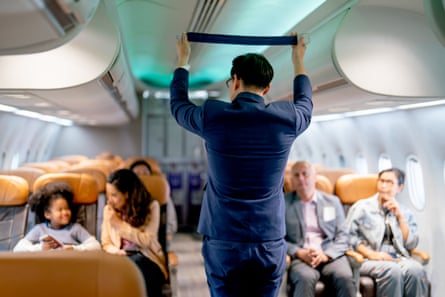
Otherwise, the main flashpoint is not sitting down when you’re told to, and the reason this gets so heated is largely economic: if you fall over during takeoff, landing or turbulence, the airline is liable for your not-at-all-unlikely injury. “So we need to tell them to sit down,” Sergei says, “and we need to be assertive. It can create an atmosphere that’s like the army.”
And how often are you told you can’t go for a pee when you want to? “I was torn one time,” Clara says. “A child needed the toilet, and the father got so angry that he told his son to wee into a bottle. But when they got off the plane, he threw the bottle of urine at my colleagues. He just tossed it at them like, ‘Here, you deal with it,’ the way you’d throw something to a dog.” Another guy got so furious he urinated on the cabin door.
Since we’re on the subject of economics, another factor at play is the relentless degradation of conditions. Much of this is down to an ongoing struggle to make savings, which has intensified during recent fuel price hikes. Certain airlines now have a 25-minute turnaround target between landing and taking off again, which wouldn’t be long enough to clean the plane even if the flight attendants were paid to do so, which in many cases they aren’t. The scenes cabin crew have seen – dirty nappies, excrement smeared on the toilet walls, crisps everywhere, all that dirty-protest urine, of course – make Thomas’s otherwise quite nihilistic conclusion probably the right one: “When you’re really exposed to every part of the population, you see that there are some really good people, but there are also completely filthy slobs.”
The job is more punishing than many may realise, physically and emotionally. “The jet lag, the very early starts, the very late finishes, and the aircraft’s cabin pressurisation all take a toll on your body,” Clara says. “When you do four takeoffs and four landings in the same day, it’s exhausting. It’s not really something you could do for your whole life.”
Thomas says: “When you spend eight to 12 hours shut inside a metal tube in the sky, it’s not like being in an office with a colleague you don’t like. You can’t just step outside for a smoke.” And the market intercedes once again, to make everything slightly worse (this is mainly on budget carriers): some pay commission on in-flight sales, so crew start to clash when the senior puts someone else on bottled water so they can sell the bloody marys themselves. Clara has seen a cabin manager “so busy selling perfume that the pilots had to perform a go-around (when an aircraft aborts its landing procedure and returns to the air). That costs the airline thousands. Applying full power and climbing away again burns an enormous amount of fuel. On top of that, you’re paying for your parking stand at the airport for longer. Commission honestly makes people stupid.”
The rise in air rage, then, feels less surprising the closer you look: in any given flight, some people will be on their very last nerve. Some because they’re on their 10th pint; others because they’re mindful of how high the stakes are, which you sometimes forget until someone’s head gets sucked out of an aircraft window (which happened last weekend). The real puzzle is why there’s not more air rage in the other direction; no, not Bristol to Krakow – crew to passengers.
Additional reporting by Ethel Pemberton-Girard
*Some names have been changed




 English (US) ·