
 1 hour ago
3
1 hour ago
3
I’ll be honest: I was prepared to grit my teeth through Sterling Point, Prime Video’s newest coming-of-age offering, which I dismissed as another by-the-numbers high-school drama. The show follows a type-A teen on a journey of sun-dappled self-discovery, escaping her native New York for an idyllic getaway on a picturesque Canadian island. It’s an unassuming, summer camp-style narrative, but in the style of last year’s seasonal phenomenon that was series three of The Summer I Turned Pretty, it manages to transcend the limits of its YA niche, revealing itself to be quite juicy.
Protagonist Annie (Ella Rubin) is a highly strung 17-year-old, still reeling from a rejection from a summer business school programme when she receives the news that her estranged maternal grandfather has left her some mysterious assets. Annie, whose mother had died years ago, and her twin Connor (Keen Ruffalo), are prompted to start digging through family secrets, much to the distress of their dad (Jay Duplass of Transparent and Industry). The two learn that they’ve inherited a house in Canada – prompting Annie to take off on a secret trip in search of answers about her late mother’s life.
We find ourselves on Sterling Point where Annie quickly finds herself a group of free-spirited friends, including Oona (Bo Bragason), the carefree and sexually forward linchpin of the group; Ellis (Jacob Whiteduck-Lavoie), the cheeky local who flies Annie out to the island on a precarious seaplane; Rory (Daniel Quinn-Toye), a sensitive New Yorker who gets compared to Timothée Chalamet; and Ramona (Amélie Elisabeth Hoeferle), who drops a bombshell at the end of the show’s first episode. It rapidly becomes clear that the group is going to spend their leisurely time swimming in beautiful lakes, boating and crushing on each other.
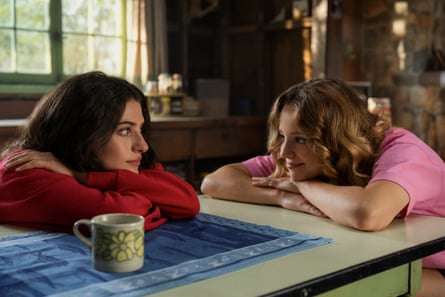
Beyond an intriguing central plot full of familial mysteries – which I can’t go into without entirely spoiling things – the show is doing something interesting in its generational context. Unlike the sort of timeless, placeless high-schoolers that millennial-plus screenwriters often dream up, these gen Z and gen alpha characters (from the creators of My Old Ass and Gossip Girl) talk like actual young people, and reflect their modern preoccupations.
Among this crew, there’s lots of fluidity, and an overflow of emotional literacy. Oona’s little sister, Maple (Mabel Strachan), is casually reading Bessel van der Kolk’s The Body Keeps the Score: “I need to find out what the score is, and where in the body it’s being kept.” The sexualities of many of the characters are a sort of question mark, slowly emerging or shifting as the show goes on, reminiscent of coming-of-age forebears such as The Half of It and Booksmart. No one’s gender or queerness is turned into a major plot point, reflecting the fact that more than one in five gen Zs identify as LGBTQ+. I laughed out loud at a quip about Oona, who, like her own mother, has repeated noncommittal flings that don’t turn into anything serious. “So she’s avoidant attached? We can work through that,” says 17-year-old Connor.
The bounds of the YA genre, and of television, feel pretty flexible here. Lines get blundered a few times, and the cameras keep rolling – since the young actors were explicitly encouraged to improvise on set. There are moments where this can fall a bit flat: a punchline doesn’t quite land, or you experience the metaphorical emotional equivalent of seeing a boom in shot. But this also allows for a looser, more authentic feel. The plot and pacing take the same approach – in the spirit of Duplass’s Transparent, sometimes a plotline gets teed up and then completely disappears, subverting the usual rules of television and making things feel more frenetic.
Again, there are drawbacks to this approach. More than once, the show contains what feels like a glaring plot hole. But the strangeness of these plotting and script flourishes creates an electricity that is actually more interesting than the love triangles, paternity secrets and other age-old devices at play here.
In April, season three of the once boundary-pushing teen drama Euphoria was met with flop reviews. The darkness that had once distinguished and sustained the show had spiralled out of control into a nightmarish, violent and hallucinatory sex fest. The show’s first season, much like Skins, upended the glossy, sanitised teen TV of the 2010s, giving us something that felt gritty and real. Perhaps now we’re seeking an escape from this. “You turn on Netflix and it’s, like, One Tree Hill and Gossip Girl. They’re all trending again,” Canadian creator Megan Park recently told Teen Vogue.
This feeling of refuge is enhanced by the fact that phones and social media barely feature in the show, despite the fact that teenagers now average more than eight hours of screen time per day. Technology is swapped for the ambient sounds and textures of nature, as well as real-life conversation, with all of its accompanying miscommunications and deceptions.
If escapism is the brief, then Sterling Point fulfils it expertly. Sure, it doesn’t carry the intensity or the existentialism of its edgier counterparts. But I was surprised by how long I wanted to stay with these characters and inhabit their island bubble. It kept subverting my expectations. I didn’t want to go home.
-
Sterling Point is on Prime Video







 English (US) ·