 (2).jpg)
 1 hour ago
2
1 hour ago
2
“It’s all about tuning into the culture of the sea,” helmsman Chris O’Brien tells me, scanning the rippling cobalt horizon from the wheel of a catamaran. “People find the water, and the meditative experience of sailing, healing.” Meditative isn’t a word that usually comes to mind when talking about cross-Channel ferries on a bank holiday weekend, but this is no ordinary ferry.
Launched last year, SailLink operates a largely wind-powered (engines are only used when necessary) service from Dover to Boulogne up to five times a week between April and mid-September, with a new Shoreham to Fécamp route due to start trials later this year.
Being able to bring bikes on board and swerve large customs queues are big draws for many travellers (officials come to the boat to check documents, so there’s no waiting around in terminals). For my two teenage sons, however, the clincher is a chance to have a go at sailing, and turn a four to five-hour journey into an adventure.
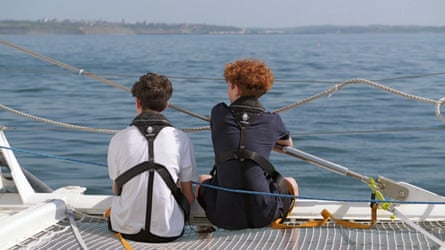
We arrive in Dover by train, strolling to the marina in 15 minutes, past the town’s beach and the elegant Georgian terraces of Waterloo Crescent, before reaching SailLink’s designated pontoon. Less than 45 minutes later we’re on board, watching Dover’s castle and white cliffs recede as a few of the more eager passengers help to haul the sails.
The catamaran can carry 12 passengers. Among them are Paul and Caroline Docherty from York, who took a train to London and cycled down through Kent. “The cycle was hot and unpleasant so we thought maybe we’d just sail from Hull next time, but I’m sold,” says Caroline. “I’m loving it.” So, too, are my sons who, after a lesson in steering from Chris, have sprawled out on the nets at the front of the boat, looking out for dolphins as we cut a course to Boulogne.
On this calm, sunny day, we’re lulled by the gentle lifting and sinking of the boat and, by the time we arrive in Boulogne, we’ve swayed ourselves into a gentler rhythm, tuned into the wind, the waves and the tides.
It’s a fitting approach to Boulogne-sur-Mer, a city so deeply shaped by the sea it anchors its name to it. Historically a strategic link between Britain and France, today it’s still France’s largest fishing port, home to a venerable fish market and Europe’s largest aquarium, Nausicaá.
Swimming against a tide of visitors flowing into Nausicaá, we pick up ebikes and trace a route north along the Vélomaritime cycle path to Cap Gris-Nez. As we pedal along the coast, passing Wimereux’s brightly coloured belle epoque villas, dipping into the sea from Ambleteuse’s bleach-blond beach and weaving inland through fields stippled with catapulting skylarks, it feels as far from the flat, industrial and battle-blitzed stereotype of the Pas-de-Calais as it’s possible to get.
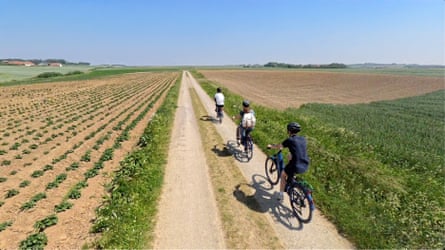
At Cap Gris-Nez, the Channel narrows to its slimmest point and we peer out towards Kent, buffeted by the breeze as we eat baguettes stuffed with gooey cheese.
Back in Boulogne, we call in at the Maison de la Beurière, the house of a typical local fishing family, presented as it would have been in the late 19th century. The museum’s former head, Jean-Pierre Ramet, tells us how dominant the sea was over the lives of these families. The sea was both respected and feared, he adds: “The arrival of the radio, with its scientific weather forecasts, prompted a huge decline in religion here.”
With our forecast still looking sunny, we leave the coast but not the water, travelling inland by train to Saint-Omer. A few hundred metres from the town’s elegant chateau-style railway station is Boat’Om, a stylishly restored merchant péniche (barge), which will be our home for the night.
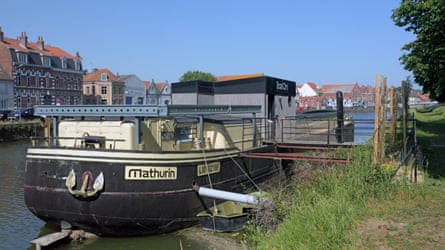
A long way from the boat’s later incarnation as a nightclub, owner Angélique Boulet transformed the péniche into guest accommodation with four bedrooms and a huge open-plan kitchen three years ago. Moored along the Canal de Neufossé, 20 minutes’ walk from the city’s cathedral, Boat’Om is a serene oasis in the heart of the city. We drift towards one of its window seats and watch reflections from the water ripple across its wooden ceiling as ducks, and the odd evening rower, paddle past.
The idea is to offer visitors a chance to disconnect, Angélique tells us. “We are in the city but all around us are peaceful marshes. You don’t realise that if you come by car, but by bike you feel it.”
after newsletter promotion
We take her advice the following morning, collecting rental bikes from Saint-Omer’s tourist office and pedalling just north of the city to explore the Audomarois marshes, a Unesco biosphere reserve. At the visitor centre, La Maison du Marais, we pile into a traditional bacôve boat and glide silently into a maze of quiet channels.
Our guide, Hippolyte Petit, explains that until the seventh century much of this area lay under water. Later, monks and farmers dug canals, creating a lattice of waterways to support the market gardens that still survive today. For centuries, the gardens’ prized cauliflowers and endive were transported to market by boat and, even now, France’s last postal boat service operates here, delivering mail to isolated waterside homes.
Later we meet Rémy Colin, of Les Faiseurs de Bateaux, the last traditional boat-builders in the marshes. His workshop creates bacôves – flat-bottomed boats used for transporting produce – using oak from nearby forests, but the boat-building business is difficult, he says. A sideline running boat trips, tours and dining experiences helps sustain the workshop. In medieval times, these boats would have been common throughout northern Europe. Now they only exist in the Audomarois. “We’re not just the last boat-builders but also the last boat-maintainers,” he tells us. “If we stop, they will disappear.”
That poignancy is brought into focus on our final night, which we spend deeper in the marshes at La Fermette de Marie Grouette, a waterside guesthouse only accessible by boat. Owner Muriel Richart collects us from a prearranged spot and steers us to her pretty whitewashed cottage, where a supper packed with local cheeses, smoked fish, salads and warm bread is served in a hamper so that you can eat wherever you like, including out on the water.
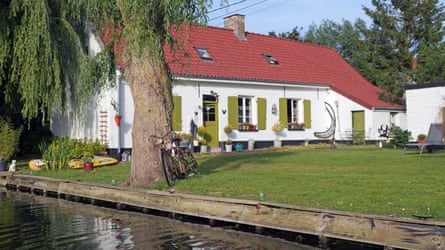
Before the light disappears, I take one of Muriel’s kayaks and paddle out into water that looks like molten gold. Droplets of liquid amber fall from my paddle as I go and, around me, the marsh feels almost jungle-like, as moorhens squeak, great crested grebes bark, chiffchaffs chirp and wood pigeons throatily coo.
The following morning, we reluctantly begin our journey home. This time, we cross from Calais to Dover on a P&O ferry – the last remaining foot passenger service on the route. Standing on deck as we leave the shore we gaze at clouds bubbling ominously above the hazy horizon. The water that carried us here will soon rise and drift inland, before falling and returning to the sea. For days we’ve been immersed in its cycle. Or, as Chris would perhaps say, we’ve been learning to go with the flow.
The trip was provided by Visit Pas-de-Calais. One-way foot passenger fares on SailLink cost £85 per adult and £30 per child (last crossing 20 September) and on P&O from £30 in the summer months. Boat’Om rental starts from £250 per night for two, self-catering. Doubles at La Fermette de Marie Grouette start from €94 (£81), B&B







 English (US) ·