
 1 hour ago
2
1 hour ago
2
This – only the second photography exhibition in Dulwich Picture Gallery’s history – is a quietly contemplative but gripping show that traces two intersecting developments: the construction of the modern urban environment and the language of photography.
Focusing exclusively on works from era-defining photographers of the 20th century made in cities across the US, it’s a concise overview that begins with the pictorialist pioneers of New York, Alfred Stieglitz and Edward Steichen, and keeps moving through masterpieces, starting with early examples of social documentary photography – Dorothea Lange’s Migrant Mother and White Angel Breadline, and Lewis Hine’s emblematic portrait of the high-steel ironworker Victor “Frenchy” Gosselin working on the construction of the Empire State Building.
All the greats are here: Ilse Bing, Mary Ellen Mark, Diane Arbus, Saul Leiter, Richard Avedon, among others. This is partly because this show is a bit of an unusual beast: it exclusively presents works belonging to the DNB Savings Bank Foundation collection. That means the curatorial choices are limited.
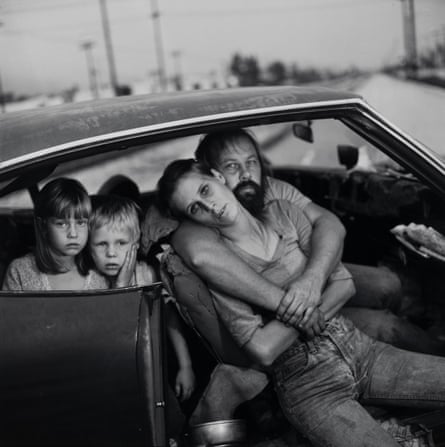
A series of short film pieces offer other interpretations. A 44-second clip of footage of the White Angel soup kitchen in San Francisco in 1931, where Lange’s indelible Great Depression image was made, gives an entirely different impression of the place from the grim loneliness depicted in the photograph. Set to an upbeat swing soundtrack, we see a lively community presided over by a jovial matron who distributes food and repairs clothing with a smile.
Many of the photographers in the first part of the show trained as painters, and it shows in the glorious attentiveness to composition and light. Aaron Siskind’s Harlem Document reflects the influence of his friendships with Rothko and Kline, searching in Harlem’s torn posters and peeling paint for his own kind of abstract expression that also created a new photographic language for social protest.
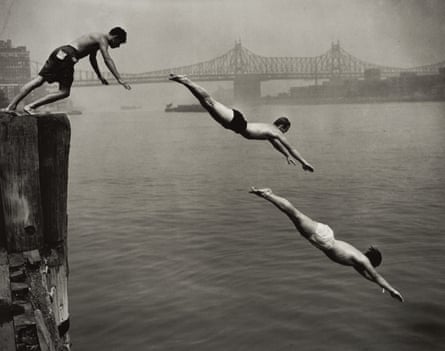
From the Great Depression to the New Deal, urban construction, regeneration and optimism soon slide into something more sinister. Images of solitary figures against the immensity of the city recur – Louis Faurer’s 1949 Looking at the RCA Building at Rockefeller Center says it all – an anonymous figure in a fedora looks towards the building, so mighty it fills the whole frame.
At night, a city’s tensions rise to the surface, and all the weirdos come out. The highlights are the images that revel in this, like Weegee’s ominous, sensationalist snapshots of New York after dark, depicting murders, awful accidents and the odd moments only a city can yield – a person’s face, eyes closed, juts out from a column in an urban passageway; a large clock in the background pulls your eye into the inky shadows.
There is a work of achingly simple genius by Roy DeCarava. Hallway is a photograph of an empty corridor in a tenement building in Harlem, much like the one the artist grew up in. It’s lit dimly by a single lightbulb, almost entirely swallowed by shadows, as the lines of the walls draw your eye in and down the space. DeCarava’s claustrophobic image makes you feel what it is to stand in that space. He finds the richness and expressivity in the colour black, as complex, volumetric and varied as any other hue.
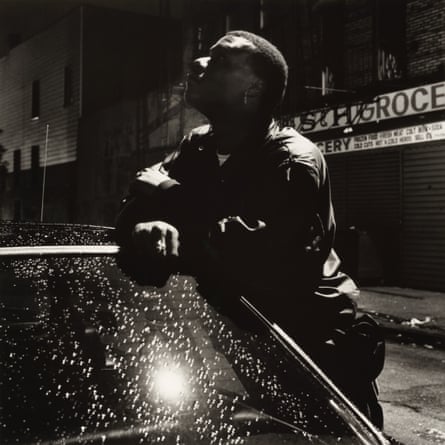
The exhibition as a whole retells the American narrative of the city – almost all of the photographers here are first- or second-generation European immigrants. It also shows how photography became a way for artists to deal with the overwhelming nature of the city, to try to take hold of it, to make it their own – or try, like Garry Winogrand, to disappear into it completely, to come closer to “not existing” as the photographer described his process, a quote emphasised on the exhibition wall. Portrait of a City is about the multiplicity of quiet-but-dazzling instants that happen every day – like Peter Hujar’s Richie, standing to reflect for a second in the rain on a street in New York at night, raindrops glimmering on a car windscreen.
We move through the 60s and 70s, where the hair gets hipper and politics get more intense, and end up on the subway, engulfed by 1980s Leica shots that Bruce Davidson made on New York’s graffiti-covered trains. Here we’re in motion again, in the place where city life collides across culture, age, race and class. People go to celebrations, to work, fall asleep, fall in love, fight. The crimson light of sunset skies bathes the carriages in a beautiful, sensuous glow. The train keeps moving. And the unstoppable city remains in maddening, merciless motion.
-
Portrait of a City: A Century of American Photography is at Dulwich Picture Gallery, London, until 4 October






 English (US) ·