 (2).jpg)
 1 day ago
10
1 day ago
10
It started so well. A catamaran full of loved ones floating into the azure, taking pics, feeling glam, anticipating the sun sinking over the yardarm. I’d been reunited with my sister and family, who live in Australia, for the first time in three years, after Covid. Her husband, a fearless Australian giant, had got into sailing and offered to take me and my then 77-year-old mum, along with their three teens, out in the south of France for my sister’s 50th birthday. I knew sailing could get rough – my dad capsized us at the mouth of the River Dart when I was little – but it’s not every day you get such a generous invitation. How could I resist?
It was October. I was manifesting warm, gentle conditions, but instead the wind blew ferociously and stubbornly the wrong way. Before we knew it, we were charging up mountainous waves, then crashing into the void beyond. Our captain calmly steered while I sat below, feeling as if I was in a disaster movie, at which point I realised I hadn’t even located the lifejackets.
Later, in safe harbour, I studied the wind speeds for the coming week and felt anxious dread about all of us dying. I wanted to beg our captain, who, along with his children, was far more daredevil than me, my sister and my mum, to let us hug the coast the entire holiday and use the engine.
Many hairy (to my landlubber mind) days ensued. I would point out the forecast to the captain – “look at the potential gusts!” – who would reply that it wasn’t that bad. The crazy gusts came, at one point creating an urgent need to get the mainsail down. But the sheet (rope) was stuck. “This is it,” I thought. The captain and my nephew eventually found a resolution. Another violent gust broke the sheet for one of the foresails.
Calamity can happen at sea even when at anchor. The galley had steep steps down to the bunks on either side, and one evening Mum fell backwards down them. With our hearts in our mouths, we rushed to help. Luckily, nothing was broken – she was just shocked, battered and bruised.
On the blowiest day, we anchored at a beach and went on a long walk. There’s something lovely about watching your floating home bobbing peacefully from the shore … until you realise it’s dragging on its anchor and heading straight for a Saint-Tropez regatta race. That night, I lay in my bunk, the sound of wind lashing the fibreglass hull, hoping we weren’t quietly drifting into the path of an oil tanker.
On our return voyage, the wind was more in our favour, but the sea still tossed the boat about like a toy. The galley had a sliding door to the cockpit, the catch of which was temperamental, which meant it slammed open and shut whenever we suddenly lurched. Eventually, the door got jammed in its closed position, so, to get in and out, we had to hoist ourselves up through the hatches above our bunks. But Mum – tiny, old and still sore – couldn’t do this.
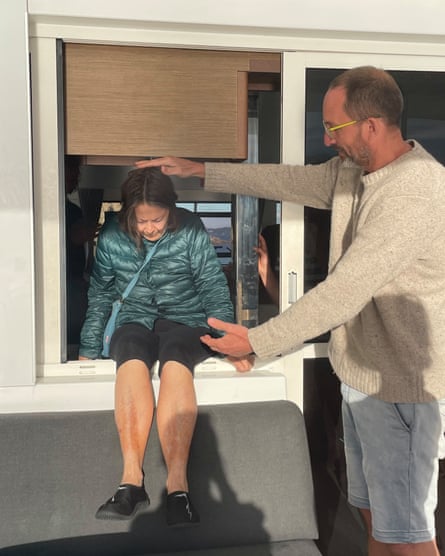
She stayed in the cabin for at least 24 hours, uncomplaining (as always). But when we wanted to explore the island of Porquerolles, we couldn’t leave her there, unable to escape. So we cleared the draining board, lifted Mum on to it and very carefully posted her through the window. This became the defining moment of our week at sea. It was far from the bikini-chilling holiday I’d hoped for, but I was grateful for the bonding adventure with my loved ones and the complete distraction from my land worries and chores – and to my captain for being extremely patient with his naysaying guest.







 English (US) ·