
 1 hour ago
1
1 hour ago
1
The importance of green space in Britain’s increasingly urban landscape – from city parks to community gardens and allotments – is unequivocal. Public Health England reports that regular exposure to green space reduces stress and improves wellbeing and physical fitness, while the Natural History Museum has highlighted its value in cooling city infrastructure and reducing pollution. Functional cities depend on functional greenery, yet the upkeep of these vital environments remains precarious. With parks and green spaces classified as non-statutory services, local authorities continue to slash their funding, relying increasingly on volunteer groups to maintain them.
A leading voice advocating for change is John Little of Care Not Capital, a community interest company offering free training for gardeners working in the public sphere so that they can have a greater influence on the spaces they maintain and those who govern them. “Green spaces are not sustainable unless you have someone looking after them,” says Little. “Yet in the public realm, the investment is often about infrastructure – overly designed landscapes and extravagant architecture – and rarely the ongoing care.” Investment in skilled gardeners, he argues, leads to positive outcomes far beyond good horticultural upkeep, from biodiversity increase and climate crisis mitigation to better community engagement and reduced antisocial behaviour.
Little partnered with garden designer Susanna Grant to launch Care Not Capital last year, enlisting experts to deliver free training across a series of study days held at his much-celebrated garden Hilldrop in Essex. The inaugural course in 2025 saw 18 professional public-space gardeners develop skills in habitat creation, biodiversity surveying and community engagement. “By training gardeners to work in more creative, ecological and biodiverse ways, we make green spaces more engaging, more inclusive, and more valuable to their communities.”
Much of the inspiration behind Care Not Capital stems from Little’s experience as a contractor for a social housing estate in Hackney, east London, in the early 2000s. Working alongside his brother, maintaining the estate’s formerly neglected green areas, Little saw how the presence of an enthusiastic, creative gardener yielded unexpected results. “Initially, we just started to make the place look like someone cared,” he says, but, listening to what the estate’s diversity of residents actually wanted from their green space ultimately led to Little sowing wildflowers, creating 60 new food growing allotments and planting specific fruit trees and shrubs culturally valued by residents of differing ethnicities, including medlars and grape vines. It led to far more interaction between residents, he tells me. “The role of a gardener can have such a huge impact on both places and people. If a space is cared for, everything improves.”
With Care Not Capital now completing its second year of training, I spoke with four public space gardeners transforming their local communities.
Accessibility
Katy Merrington, The Hepworth Wakefield
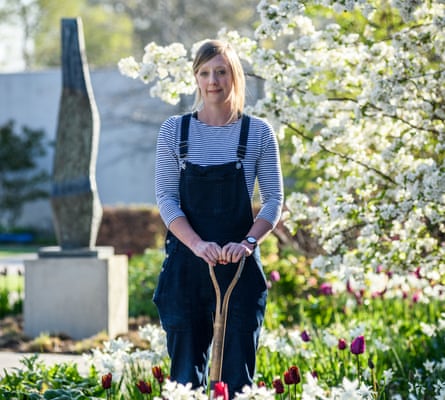
When the Hepworth gallery in Wakefield decided to convert the derelict land on its doorstep into an ornate public garden accessible for all, employing a skilled, full-time gardener was a central priority. Katy Merrington, whose title is “cultural gardener”, was in place when the garden opened in 2019: it’s a four-season tapestry of colourful perennials intersected by weaving paths and breakout spaces designed by landscape architect Tom Stuart-Smith. Leading a team of volunteers, Merrington is a regular presence in the garden, which has become a place of inspiration, respite and social interaction.
“One of the Hepworth’s missions is to inspire positive change locally,” Merrington tells me. “So to have this really top-class garden free and accessible in the city is wonderful – gardens like this typically charge an entrance fee, or you need a car to get to them.”
A 2019 study by the University of Sheffield found that the visible presence of a gardener makes visitors feel safer and more comfortable using green spaces. Merrington agrees: “Your presence makes the place feel inhabited; people love to see you working it. That study also proved that a badly kept public park adversely affects health outcomes – a park full of litter doesn’t lift your spirits, but if it’s well cared for the health outcomes are substantial.”
Biodiversity
Benny Hawksbee, Eden Nature Garden, London
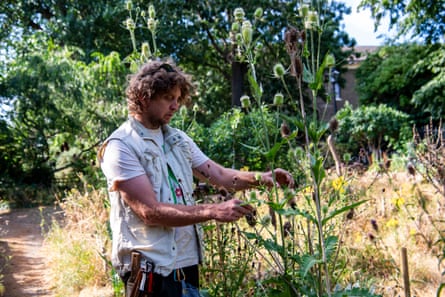
Gardener Benny Hawksbee looks after the Eden Nature Garden, a public pocket park in Clapham, south London. Employed by St Paul’s church, in whose grounds the garden resides, Hawksbee has developed the space into a haven for people and wildlife alike, from sparrowhawks to solitary mining bees. “For zone 2 London, the species list is quite cool,” he says. “We’ve had the second British recorded sightings of thread-waisted wasps from the Americas, Isodontia mexicana.”
Regularly gardening the space has allowed him to experiment with habitat provision (“adding things like leaf stacks, stem bundles, standing water”), and to monitor the garden’s biodiversity using the citizen science apps iNaturalist and iRecord. “Gardeners are the best people for recording wildlife, because they’re in the same place every week, nurturing and observing. Over time they could end up recording more data than entomologists and ecologists, even.”
Shereen Chung-Blake, London
after newsletter promotion
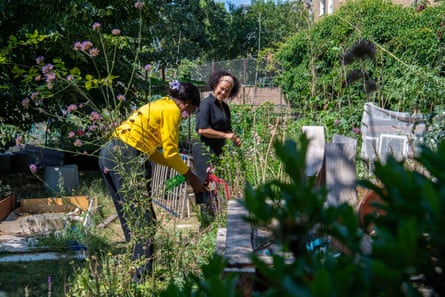
At a council estate in Camberwell, south London, resident Shereen Chung-Blake took public greening into her own hands, converting a disused patch of public lawn into a thriving community garden and allotment. “It was just grass before, and a lot of antisocial behaviour,” she tells me. “The trees were used to train bully dogs, there was fly-tipping.”
Initially, Chung-Blake – who is project coordinator for the Future Gardeners course, a free horticultural training scheme for individuals with barriers to employment – sought council funding for five food-growing beds, under Southwark’s Allotment Expansion Guarantee. “I knocked on doors and managed to get enough people involved to go ahead.”
That was 2023; the garden is now alive with birdsong and skipping butterflies; there is a pond, a rainwater capturing shed, and a significant expansion of the original allotments. As the garden’s ongoing manager, Chung-Blake volunteers her weekends and evenings in the garden. “With a green space you need someone to lead it and keep that forward momentum,” she says.
“But the garden’s had a tangible effect on community cohesion. It acknowledges the cultural richness of the many people living here, for whom growing food is part of their culture. When I talk to people over the wall, I hear all the time, ‘Oh, I used to grow that in my country,’ or ‘This reminds me of home.’ This place is becoming like a food forest, it’s really special.”
Climate crisis mitigation
Owen Hayman, the Green Estate, Sheffield
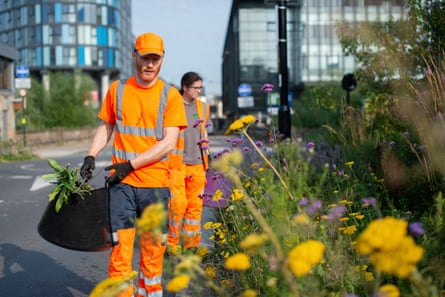
Sheffield city council’s Grey to Green scheme is a leading example of city greening. Conceived in response to dramatic flooding in 2007, a mile of sustainable drainage system (SuDS) planting beds capture rainwater runoff, mitigating the effects of the increasingly volatile climate while providing a green corridor in the city centre. Comprising complex ecological plantings, the scheme is maintained by the Green Estate, a social enterprise focused on urban and environmental regeneration.
Owen Hayman, the Green Estate’s horticulture innovation manager, tells me: “At its heart, Grey to Green is about managing flood water, but then it has the biodiversity and economic regeneration benefits, the green transport route, walking and cycling. Gardeners understand all the different functions the planting is playing, and help support them – but it takes time, observation and knowledge.”







 English (US) ·