
 1 hour ago
6
1 hour ago
6
Among the endless videos of cute animals, influencer vlogs and celebrity content, something unusual has been going viral across social media recently: omelettes. A far cry from the usual solid egg slabs served in cafes, these bright yellow omelettes are a fluffy, oval-shaped treat filled with unctuous liquid curds, which are typically sliced open to unfurl across a mound of rice. Called omurice, the Japanese dish has been called “the world’s hardest omelette to make”.
London-based software engineer Jeremy Ocampo, who goes by the social media tag OmuricePapi, has spent the past six months documenting his journey to perfect the art of the omurice online. In the process he has amassed 110,000 followers on YouTube and more than 68,000 on Instagram. “I’m Filipino, so I grew up eating rice and eggs every day, but it took going to Japan for the first time in 2025 to have my mind blown by omurice,” he says. “I was hooked: the presentation of slicing it open over your rice makes it so alluring, while you can’t replicate that texture of egg in any other dish. It’s so unique that when I got home, I decided to teach myself how to do it.”
Initially struggling to find the right nonstick pan that could allow the egg mixture to slide and fold easily, and then running into difficulties when it came to selecting the ideal temperature on his gas hob, Ocampo estimates it took him 50 tries until he finally came up with a passable attempt. “I’ve been making it three times a week and I was eating so many eggs I actually realised I was mildly allergic to them,” he laughs, adding that he now largely serves his omurice to friends. “I must have spent about £150 on 300 eggs and I’ve gone through at least five pans – but now I’m pretty consistent, and it takes me around a minute from start to finish,” he says. “You just have to keep a positive attitude if you want to keep trying and learn yourself eventually!”
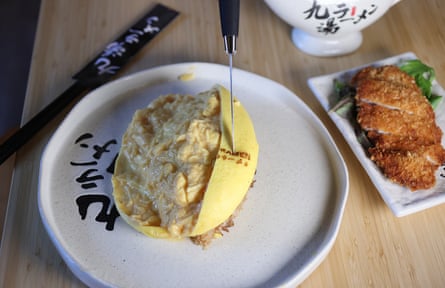
Theories differ as to the origins of omurice. Some believe it was invented at the turn of the 20th century in a western-style restaurant in Tokyo’s Ginza district; others say it emerged in Osaka in 1925, when a diner chef decided to pair an omelette with rice. Yet, it only became popular across Japan in the 1950s. “There was a period [of food] in Japan called Yōshoku, where we brought in lots of western cultural influences and it was very widespread after the second world war,” says Japanese chef and culinary expert Yuki Gomi. “Things like yakisoba and katsu curry are all examples of this western mixing, while omurice has both French and American influences. I’m 50 now and I remember growing up in the 1970s with my mother making me omurice. It was a cute dish for children, where you would write their name or a smiley face on the egg with ketchup. I have made it lots for my own daughter, although my version is flatter than the ones going crazy on social media now.”
A more traditional omurice is closer to a French-style omelette and always served over a seasoned tomato rice, with a squirt of ketchup the typical garnish. The buoyant, dome-like omurice that has gone viral over social media, however, originated in the late 1970s with omelette aficionado – and online personality in his own right – Motokichi Yukimura. Founding his restaurant Kichi Kichi Omurice in Kyoto in 1978, in tribute to his favourite childhood dish, it was only a decade ago that Yukimura’s particularly theatrical version of the omurice began attracting international attention thanks to his penchant for singing and dancing while cooking the dish.
“I spent years perfecting my version of the omurice. Then, I realised I wanted to create more than a delicious meal but a joyful experience too, so I started talking to my guests while cooking and creating a performance,” Yukimura says. “People would video my omurice and soon we began having customers queueing around the corner to get into the restaurant. Over the past decade I think I have made 100,000 omelettes. I just want to make the world happy through omurice!”
Pairing his version with a glossy, umami-rich demi-glace glaze that takes nine hours to reduce, Yukimura’s renowned dish has since spawned alternative versions in the UK. Michelin-starred London restaurant Mountain has a spider crab omelette sprinkled with sea kelp on its menu, which, although not labelled as an omurice, still slices open to splay over the plate. Buy & Bite, which has three locations in London, serves omurice with everything from Thai green curry to Chinese sweet and sour sauce.
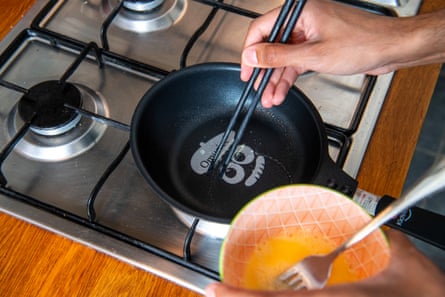
When the time comes to make my own version, I decide to buy Yukimura’s branded nonstick skillet pan, which is one of Ocampo’s go-tos. I also choose to cook on a gas hob, to ensure I can manipulate the pan over the flame at different angles. Following Ocampo’s Instagram tutorial video, I heat the pan until a speck of egg mix sizzles, pour in three beaten eggs and immediately start whisking vigorously with chopsticks to develop curds. Once the edges look cooked, I peel them away from the pan with a spatula and try to fold the omelette into a dumpling shape. It immediately splits and the liquid filling pours back into the pan. Feeling as if I’m about to be shouted at by Gordon Ramsay, I panic and let it cook further to try to fold again but it simply hardens into rubber.
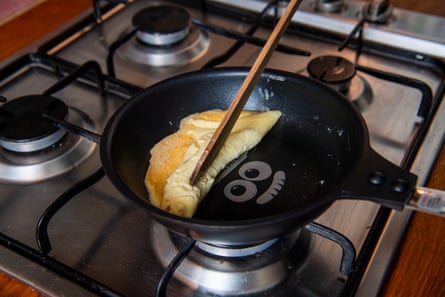
I dump it out and start over, this time letting the base cook for a few seconds longer. Thankfully, it folds. I tilt the eggy mass to the front edge of the pan and angle into the flame so it can harden. Now for the method that both Ocampo and Japanese chef Akemi Yokoyama describe as the most difficult: performing a gentle pancake toss so that folded seam can land on the underside of the omelette. Of course, the entire thing breaks apart and I’m now left with two solid omelettes for my lunch.
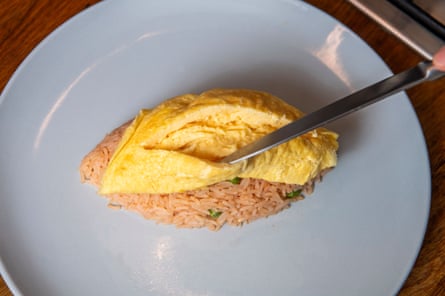
Over the course of the next week, I come to realise why omurice is described as “the world’s hardest omelette”, and why Ocampo cautioned patience and a positive attitude. The rice is simple and tasty enough – only requiring onion, Worcestershire sauce and ketchup to be mixed into a precooked portion – but my egg skills are left wanting. The several omelettes I make continually burst apart before I can roll them over my rice, and the experience of eating so many overcooked eggs is starting to make me think that I, too, may be allergic. On one miraculous occasion, I create a haphazard square version and get to taste the rich, almost sweet texture of the omurice innards. I can see why people might queue for Yukimura’s version, but if the late Anthony Bourdain thought that “the way you make an omelette reveals your character”, then I’m clearly lacking in integrity.
I’m comforted by Ocampo’s 50 attempts to perfect his version; as well as Gomi and Yokoyama’s admissions that they are yet to make the social media version of the omelette without fault. “It requires a certain amount of muscle memory,” Yokoyama says. “In Japan, people just go to a restaurant to eat it cheaply now, rather than bother to make it at home.” I think I might have to do the same. Perhaps it’s best to leave the world’s hardest omelette to the experts.








 English (US) ·