
 1 hour ago
3
1 hour ago
3
French riot police funded by UK taxpayers used teargas on asylum seekers in a bid to stop them from boarding a boat in which three women were later found dead, a charity has claimed.
Footage and photographs seen by the Guardian show CS gas canisters being fired towards groups of people on Plage du Braek near Dunkirk at 4am on Thursday. At 6am, three women were found dead in a boat near the same beach.
According to the charity Utopia 56 which took the images, staff witnessed French riot police firing the canisters at people who were trying to board the same boat in which the bodies were discovered.
As part of a £660m agreement signed by the home secretary, Shabana Mahmood, in May, 50 officers from Compagnies Républicaines de Sécurité (CRS) “specially trained in the use of riot and crowd control tactics” have been deployed using UK public money.
In a separate development, a fourth person – a man – also died on Thursday when his dinghy got into difficulty in a separate incident off the coast of Dannes.
The incidents happened hours after the busiest day for small boat crossings so far this year which saw 752 arrivals in the UK.
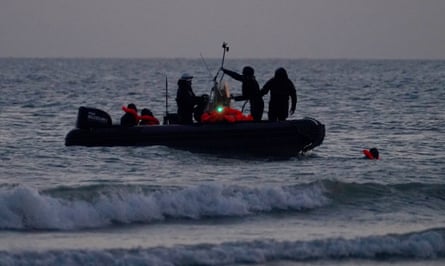
Clashes between riot police and asylum seekers took place on roads leading to Plage du Braek from 4am, Utopia 56 said.
Angèle Vettorello, a coordinator at the charity, said: “An hour before the boat carrying the women’s bodies was found, our team was right next to the beach. Riot officers from the CRS were there and were trying to stop 80 people, including families, from trying to access the beach and those people were trying to get inside the boat.
“We saw them using teargas against people and later we found at least 35 teargas canisters there. We do not know if the women whose bodies were discovered were already in the boat or were part of the group trying to reach the beach. We can see police pressure on the beach is putting more people at risk. We saw it last week and we are seeing it now and we have seen it for some time. It is terrible.”
The CRS has faced allegations of brutality and racism. In February, nine officers from the force were found guilty of beating peaceful protesters who were sheltering from teargas during the “gilets jaunes” anti-government demonstrations in 2018. Two years ago, leaked WhatsApp messages showed CRS officers had exchanged an image of a sinking small boat laden with migrants.
The CRS, although paid for by the UK, maintain “operational independence” in France and are also authorised to use water cannon, stun grenades and batons.
The French interior ministry and the Home Office have been approached for comment.
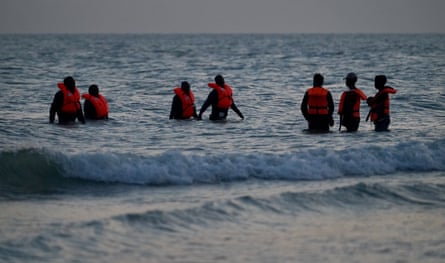
The boat on which the women’s bodies were found was brought into shore at 6am. The bodies were brought ashore after the French emergency services, including firefighters, police and paramedics, mounted a rescue.
Attempts to resuscitate the women failed and all three were declared dead. They were reported to be aged about 20, 30 and 50. Their nationalities are as yet unknown.
The man who died was in a dinghy that capsized as people attempted to board. It had arrived from Sainte-Cécile, a beach farther south, with people already aboard. It is believed to have departed from Berck, a further 13 miles south.
Six other people, including a one-year-old child, suffered minor injuries, the French authorities said. Some of those onboard were taken to hospital and a man with burns over half of his body was airlifted by a navy helicopter.
Imran Hussain, the director of external affairs at the Refugee Council, said: “Refugees are ordinary people in extraordinary circumstances, and those who risk dangerous small boat journeys do so only out of desperation. There is no legal way for somebody escaping the Taliban in Afghanistan or brutal civil war in Sudan to reach sanctuary in the UK.
“The government has even shut down family reunion for refugees, which overwhelmingly helped women and children. Fewer refugees would risk crossings if the government created safe pathways.”
On Wednesday Andy Burnham, the British prime minister, insisted the government’s plan to curb Channel crossings was working, although he admitted there was “more to do”.
This week French police were recorded saying they had orders not to stop people getting into their boats and setting off for the UK. One told Chris Philp, the shadow home secretary, as he stood on Hardelot beach, south of Boulogne-sur-Mer: “Our order is to let them go.”
More than 900 people have crossed the Channel in the past week as people smugglers take advantage of a calm sea. A total of 13,376 migrants have crossed this year, down from 24,389 at the same point last year.
A government spokesperson said: “We are deeply saddened to hear about these deaths. Every death in the Channel is a tragedy and a stark reminder of the dangers posed by criminal gangs exploiting vulnerable people for profit.
“We will continue working relentlessly with the French and our partners overseas to prevent these perilous journeys.”








 English (US) ·