
 1 hour ago
2
1 hour ago
2
About a dozen people sang along to the pulsing vibrations of drums and a tambourine in a dimly lit room in Nairobi’s sprawling Kibera neighbourhood. For more than an hour they belted out song after song, the lyrics suffused with references to Ethiopia, Jah, Zion, Rastafari and Haile Selassie I.
One song went: “No night in a Zion, there is no night there / Hallelujah there is no night there / Rastafari is our light, and we need no other light / Hallelujah there is no night there.”
The singers and musicians were members of the House of Nyabinghi, one of the main denominations, or “mansions” of Rastafari, a religion and social movement that recently came under the spotlight in Kenya after a court ruling on 15 July dismissed a petition to decriminalise the use of marijuana for spiritual purposes.
Three days later, the House of Nyabinghi – named after and inspired by a legendary east African woman whose name means “mother of abundance” or “she who possesses many things” – met for their weekly communal gatherings, which Rastafarians call a “groundation”.
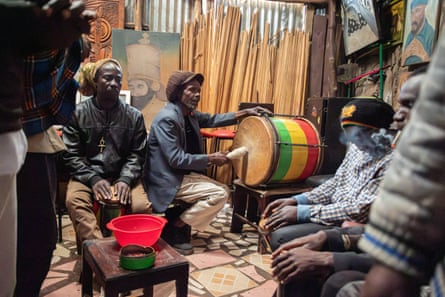
A red, yellow, and green flag and images of Rastafari’s influences such as Haile Selassie I, Bob Marley and the Jamaican political activist Marcus Garvey embellished the walls. Sizzles and crackles were often heard as some of those gathered lit marijuana, its scent filling the air.
Among those attending was Ras Orudi, who came to Rastafari after being inspired by Jamaican reggae artists such as Peter Tosh while at secondary school in the mid 2000s. “Rastafarians are not rejecting the system,” said the 38-year-old, who serves as a herbalist. “They are trying to integrate into the system while defending their rights.”
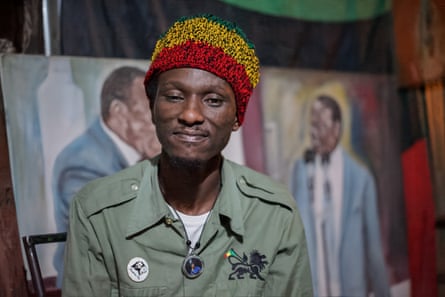
Also in the room was Ras Ndeto, who was inspired by an encounter in the early 1990s in Nairobi with a Rastafarian from Guyana who taught him “livity”, the Rastafari spiritual practice of righteous and natural living centred on a plant-based “ital” diet and the growing of dreadlocks.
The 56-year-old said the court’s decision marginalised followers of the religion and added that they would appeal to a higher court. “We still feel that we are a minority group in this country, because even our culture is still looked down upon,” said Ndeto, who holds the title of prophet and is the spokesperson for the Rastafari Society of Kenya. “We are living like terrorists in our own country.”
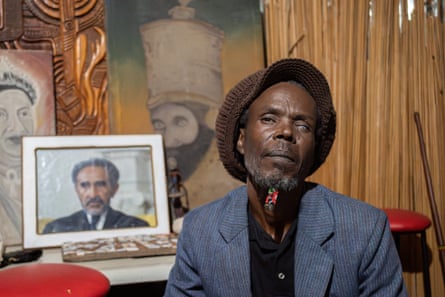
An Afrocentric religion, Rastafari is centred on the beliefs that the former Ethiopian emperor Haile Selassie I is the messiah and God incarnate, and that Black people are oppressed by Babylon – a metaphor for western capitalism and imperialism.
The movement emerged in the 1930s within marginalised Afro-Jamaican communities after Protestant leaders declared that the crowning of Haile Selassie I as emperor was the fulfilment of a biblical prophecy. The movement is named after his pre-coronation name, Ras Tafari Makonnen.
The religion was embraced around the world partly due to the influence of Rastafari-inspired reggae music from artistes such as Bob Marley and the Wailers, Burning Spear and Culture.
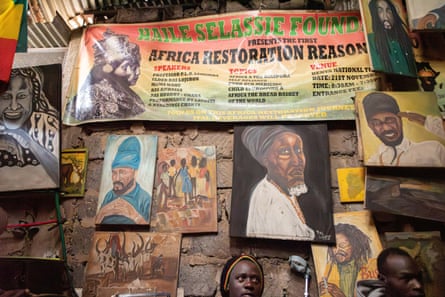
Ras Dimo, who holds the title of priest and often leads prayers in Kibera, became enlightened about Rastafari just before finishing secondary school, partly through reading books examining the connection between Black people and the Bible. “I was inspired to know that Black people are not cursed as imperialists tried to make us think,” the 43-year-old said. “We are living in a time when many people are blinded.”
Like many other Rastafarians in Kenya, Dimo was born into a Christian family and later became Rastafari. They adopt the title Ras, which means “head” or “chief” in Amharic, the most widely spoken language in Ethiopia.
after newsletter promotion
The population of Rastafarians in Kenya is unknown. In 2019, a court recognised Rastafari as a legally protected religion in a landmark ruling after a pupil alleged discrimination when her school expelled her due to her dreadlocks.
Marijuana, a product of the Cannabis sativa plant, is a sacrament in the faith, and Rastafarians believe consuming it puts them in a meditative state that helps them connect more deeply with the divine. Followers in different parts of the world are pushing for its decriminalisation. In 2023, the islands of Antigua and Barbuda approved allowing Rastafarians to grow cannabis and smoke marijuana.
In 2021 the Rastafari Society of Kenya filed a court petition seeking the exemption of Rastafarians from arrest and prosecution for cultivating, possessing and using the plant as a sacrament, or a requirement that the government create a legal framework for the practice.
The society said the law violated their rights to freedoms including of religion and equality. The court dismissed the petition on 15 July, saying the society had failed to prove that the law unconstitutionally violated Rastafarians’ rights, among other reasons.
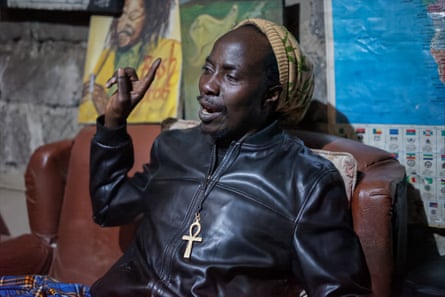
Ras Masinde, another follower in Kibera, became curious about Rastafari as a child after encountering a man with dreadlocks. He became rebellious, refusing to cut his hair, and after finishing secondary school in the 1990s, started growing dreadlocks and reading about the Rastafari religion, before eventually finding a community.
“We as Rastafarians are urging Black people to go back to their roots and culture,” said the 50-year-old. “We fyah bun (denounce or condemn) colonialism and imperialism, and we say that every man and woman and child … is equal before the eyes of the almighty the creator.”
He issued a rallying call: “Free up the herb. Free up the ganja seed.”





 English (US) ·