
 1 hour ago
2
1 hour ago
2
At Chad Green’s house in Davison, Michigan, a brood of baby chicks roamed around the idyllic green lawn as US senators pitched a couple dozen voters on why they should turn out for the hopeful one, Abdul El-Sayed.
Green, a retired federal firefighter, hosted a similar small gathering for Mallory McMorrow, who was running for the US Senate before she dropped out of the race in early July, narrowing the contest to El-Sayed, a progressive insurgent campaigning for universal healthcare, and US representative Haley Stevens, who has branded herself as a workhorse.
Green, 54, sees himself as a more moderate Democrat, and originally aligned with McMorrow. After she dropped out, he looked into El-Sayed and Stevens, and resonated more with El-Sayed’s policies.
“I’ve never seen people more excited about a candidate,” Green said. “I feel like there’s not going to be excitement for the Republicans to vote. And I feel like there is excitement for Democrats to vote for Abdul.”
The Michigan primary is, perhaps, the most contentious Democratic primary this year – and a test for the party’s future. Voters are weighing the policies and personalities of the candidates as they once again consider the thorny question of electability: who can win this purple state in November, and potentially push the party towards a majority in the Senate?
Recent surveys have shown El-Sayed pulling ahead. A nonpartisan Emerson poll this week of likely Democratic voters found 54% intended to vote for El-Sayed compared to 39% for Stevens, with a stark age divide. Voters under 50 broke for El-Sayed by 42 percentage points, while voters over 60 preferred Stevens by a 14-point margin, it showed. Independents were siding with El-Sayed by a 27-point margin.
Stevens, 43, has represented Michigan’s 11th House district since 2019, after flipping the seat. She has been endorsed by Senate minority leader Chuck Schumer, Michigan governor Gretchen Whitmer and Gary Peters, the retiring senator who holds the seat she and El-Sayed, 41, are now running for.
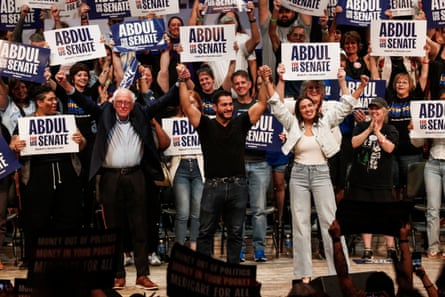
El-Sayed, an epidemiologist who served in health director roles in Detroit and its county, counts leading progressive officials among his supporters, including US senators Elizabeth Warren and Chris Van Hollen, who rallied with him in Michigan last weekend alongside a host of representatives and former elected officials.
The winner of Tuesday’s Democratic primary will face Mike Rogers, a former congressman from the state who was also the Republican nominee for US Senate in 2024, when he lost to Elissa Slotkin.
El-Sayed, often mentioned alongside democratic socialists who have won a string of party primaries ahead of this year’s US midterm elections, is not himself a democratic socialist: he says he is a “capitalist who understands how capitalism works”, and wants to regulate monopolies and oligopolies.
But the race has become a key focal point in the rise of the left flank of the Democratic party, and its potential limits – especially after a wave of wins in solidly blue districts across the country.
More than $40m has poured into the race from outside groups supporting Stevens or attacking El-Sayed, including from groups associated with the American Israel Public Affairs Committee (Aipac), a pro-Israel lobby. AdImpact shows more than $60m in ad reservations and spending to benefit Stevens.
Misleading ads have attacked El-Sayed for “disrespecting women” while tying Stevens to Barack Obama, who has not endorsed in the race, but previously praised Stevens’ work on the auto industry rescue plan. The Obama connection sits prominently in the minds of some Black voters in Michigan, who cite Stevens’ work with the former US president as key to their vote in the primary.
El-Sayed has seized on the major outside spending against him and turned it into a central line of attack against Stevens. Stevens points to an A-rating from End Citizens United, a group dedicated to getting money out of politics, and says she feels “very strongly” about campaign finance reform.
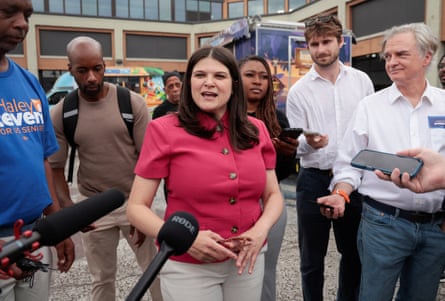
While talking to reporters outside Plymouth United Church of Christ in Detroit last Sunday, Stevens held up a note passed to her during the church service from a member of the congregation. “Had I known that you would be at church today, I would have brought my checkbook,” the letter said, according to Stevens, who added that most of her direct campaign contributions come from small donors.
In the waning days of the primary, Stevens attacked El-Sayed for not releasing his full financial disclosures, which he subsequently did. She also often accuses El-Sayed of seeking fame, pointing to his previous podcast, which he co-hosted for Crooked Media, his book, and a website purchase for El-Sayed for president.
El-Sayed said he purchased URLs for various offices as a defensive maneuver so others couldn’t snap up the websites and use them against him, and said he doesn’t understand the line of attack on podcasts or books: “I would think that you’d want to send a nominee who’s comfortable doing podcasts.”
The campaign has grown increasingly tense in its final weeks. Earlier this month, El-Sayed faced backlash over remarks that he later clarified were in reference to Democratic senator John Fetterman of Pennsylvania – not his primary rival. El-Sayed had said a left-wing victory over Fetterman – who campaigned as a progressive but has moved sharply to the right in office, particularly on Israel – would be akin to putting an “ogre on a pike”. Stevens responded: “Thank you for clarifying that you didn’t call me an ogre.”
And in a Twitter post this week, Stevens criticized a video where El-Sayed criticized Aipac, with Stevens saying: “Everyone in America understands you want to blame all of your problems on Jewish Americans.”
Stevens said she isn’t campaigning on “false promises” or “slogans”, a nod to El-Sayed’s central issue of the Medicare for All proposal of universal healthcare. “I am offering a path to win, to make sure that Mike Rogers goes back to Florida for a second time, so that he doesn’t get to go into the Senate and return nothing for us, just rubber-stamping Donald Trump,” she told reporters last weekend.
El-Sayed contends that universal healthcare requires fundamentally changing Congress – by electing politicians who will fight for it. “If you don’t fight for certain things, you’re never going to get them,” he told the Guardian.
Where the voters go
Stevens stood in front of Black congregations on a recent Sunday morning, joining in worship services before telling the churchgoers who she was, and what she could deliver.
Black voters – who make up about 20% of the Democratic primary electorate – have expressed some skepticism of El-Sayed. Black voters in the state have tended to side with more moderate candidates in primaries. Polls of the race show Black voters overall siding with Stevens.
At Hartford Memorial Baptist church in Detroit, Stevens mentions Obama and Hakeem Jeffries, the Democratic minority leader in the US House of Representatives. She says she prayed for her parents. Her dad, she said, always told her: “Do not be the smartest person in any room; be the hardest working.”
Later, at Plymouth United Church of Christ, she told the congregation that she “could have stayed comfortable” in her House seat.
Scott Benson, a Detroit city councilman and a deacon at Plymouth, said he’s been a longtime supporter of Stevens because of her focus on “kitchen-table issues”. He worked with El-Sayed when he was the city’s health director, he added, but El-Sayed’s politics don’t align with his.
“I am very pragmatic. I’m very kitchen table. I’m about jobs,” Benson said. “Other issues just really don’t align with mine and so, great guy, but Haley Stevens’ policies align with mine, and her effectiveness as a legislator is also a very big deal to me.”
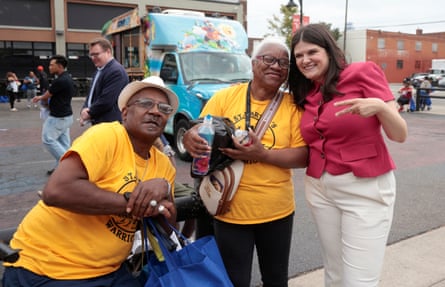
After services ended at Plymouth, people stopped to get photos with Stevens and tell her she had their vote . One woman said she had seen Stevens’ actions, including the work she did under Obama. “I know that there was hope then,” she said. “There’s more hope for us now in Michigan.”
Willie Goston, 71, of Redford, said he and his wife filled out their ballots two weeks ago – two votes for Stevens. He knew he would vote for Stevens right away, citing her work with Obama, and her connection with US representative James Clyburn, a longtime South Carolina legislator.
“She’s an amazing politician, and she seems like she’s honest, seems like she’s not going to go back behind and do no underhanded stuff,” said Goston.
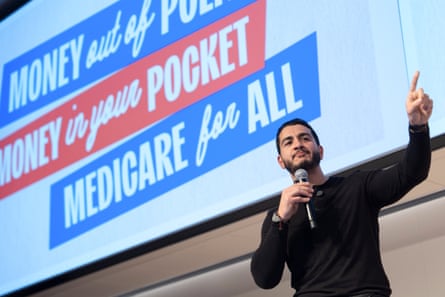
On Sunday afternoon, in Rouge Park in Detroit, volunteers and supporters of El-Sayed rallied, getting egg rolls and ice cream from food trucks as they listened to elected officials and activists talk about the candidate, frequently calling on his central slogan: “Money out of politics, money in your pockets, Medicare for All.”
El-Sayed has hosted rallies and door-knocking launches throughout the campaign, his ground game aided by groups like the Working Families Party, the United Auto Workers and the progressive activist network Indivisible . His campaign has more than 10,000 volunteers and is knocking on nearly 10,000 doors per day, he said.
Justin Daniels, 45, who attended the park event, said the dividing line in the race is establishment versus non-establishment. Daniels, who is Black, said if younger Black voters tune into the primary, they’d probably lean toward El-Sayed, while for older Black voters it’s more of a toss up.
But he thinks El-Sayed can win in November. “I see him winning over Republicans, because what a lot of people don’t understand is they’re getting their benefits cut just as well,” Daniels said.
El-Sayed said he believes his campaign will do well with a number of different subsets of Democratic voters, including the Black community. “My relationship with the Black community isn’t built on photo ops and all of a sudden crossing 8 mile because somebody told you that’s what you need to do,” he said. “My public service is built in the city and county, and I’ve been building these relationships for a very long time.”
The electability question
El-Sayed, who is of Egyptian descent and Muslim, said the electability argument is often a coded way of questioning his name and religion. He has been “Abdul in Michigan” his whole life, including as a high school student after September 11, and still was voted captain of the football team the next year.
“Michiganders are open-minded. They’re big-hearted people,” he told voters at Green’s house. “And the funny thing is, when they say I’m unelectable … that’s not a comment on me. You know what that’s a comment on? It’s on you. They’re trying to say that you all, Michiganders, who I know to be open-hearted, kind, thoughtful people, are not big enough to see past my name. And I’m betting otherwise, because I’ve been betting otherwise my whole life.”
Voters have shown a strong anti-incumbent bias in recent polls. A recent CNN poll found that a majority of voters think US Congress would be better off if most sitting members were unseated in the midterms.
El-Sayed said he regularly has people attend his town halls who tell him they voted for Trump, and now would for him.
He is trying to both inspire people who haven’t been voting to come out and back his campaign, and win over people who voted for Trump, but feel betrayed by the administration’s actions.
“Why did it go for Bernie, then Trump, then Biden, then Trump?” El-Sayed asked the group at Green’s house of Michigan’s recent voting history. “And either it’s because we can’t make up our minds – which, y’all been in Michigan long enough to know, we know what our minds are – or it’s because we keep going to the buffet, and not finding what we really want. So what happens if you give an alternative that is actually against the system, the corruption on both sides of the aisle, that’s also not a megalomaniacal, narcissistic billionaire asshole?”
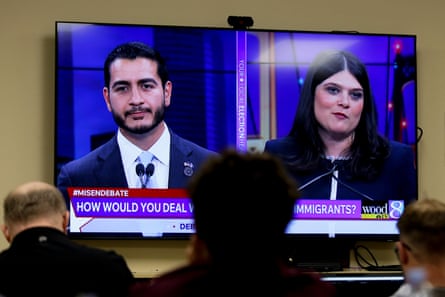
Stevens points to her record of winning over Republican voters in a tight congressional district. She notes that she has beaten Maga four times. When she and El-Sayed both ran (in separate races) in 2018, Stevens won a six-way House primary. She is the first Democrat to hold the 11th district seat for a full term since the moon landing, she said.
As to which of the two candidates is more poised to win in November, “I think the Republicans have answered that for us”, Stevens said, pointing to a leaked phone call where Rogers said he had a better shot at flipping the seat if El-Sayed won the primary.
Videos of Stevens’ heavy Michigan accent, where she said she was going to fight with “a little bit of stick it to ‘em”, have circulated widely online in the final weeks of the campaign. Stevens has moved to embrace the phrase, putting it on campaign signs, though also suggested its virality was driven by “cool kids on the Internet doing the cool kid chatter”, some of whom “might be the coastal elites”. Both Stevens and El-Sayed were born in Rochester Hills, a suburb of Detroit. El-Sayed told his supporters not to “make fun” of Stevens, calling it “unkind and unhelpful”.
“I’m going to run through anything and anyone to cut the best deal for Michigan,” Stevens told reporters at an event in Detroit last weekend. “So yeah, they can make fun of my voice, but I sure as damn well am going to make sure we’re heard in the halls of power.”
Benson, the Detroit councilman, said he believes El-Sayed’s positions are too far to the left for a purple state. Trump won Michigan in 2024, after Joe Biden won it in 2020.
“I believe in the centrist Democrats,” he said. “So I’m a centrist Dem, I’m moderate Dem, and I’m proud of that fact. I just believe it’s what we need to be competitive in the state of Michigan. Those views, his views, they are very well accepted in other places. But when you have a purple state, I’m not sure that’s going to play well here.”
Robin Evans, a 75-year-old registered Democrat who attended the gathering at Green’s house with her two siblings, said she would be voting for El-Sayed. His background in public health, and focus on healthcare, appealed to her.
“They’re trying to sell the fact that he’s not electable, but I’m not doing that,” she said. “I’m voting for whom I feel is right, not for electability.”
Why this race is so closely watched
Some of El-Sayed’s potential future colleagues are betting that his win, and other progressive wins this cycle, will change the tenor of what Democrats in the Senate are willing to stand for. US senators Elizabeth Warren, of Massachusetts, and Chris Van Hollen, of Maryland, rallied with El-Sayed in Michigan last weekend, saying they wanted fighters like him to work alongside.
Voters want people who have courage and aren’t afraid to stand up to Trump, but also aren’t afraid of losing their seat, Warren told the Guardian, so they’re committed to making meaningful change.
“Remember, the Senate is actually a pretty small place. For Democrats to be in the majority, shoot, there’d only be 51 of us,” she said. “You bring us just a few more progressive fighters, and the whole tone of that place changes. We’re in the fight now. We’re pulling people over. It’s shifting, but bring us some new blood. Bring us some fighters. Bring us more energy into this. And watch what we can do.”
El-Sayed is tapping into deep-seated anger among the electorate, like dysfunction in the healthcare system that allows insurers or AI programs to say whether a doctor-ordered test or medication could be covered, Warren said. “I think that’s going to connect with people who aren’t even part of the Democratic primary.”
Van Hollen, the Maryland senator, said he thinks El-Sayed has a better chance of winning the general election because of his ability to mobilize and motivate voters, who see his campaign as not a simple test of left versus right, but about uniting against political corruption and concentrated economic power, a “much more universal” message.
Washington is in a bubble, Van Hollen said, and too caught up in pundit-class chatter, but the general public is “way ahead” of Washington on upending politics as usual. The pre-Trump status quo wasn’t working, either, he said.
“Voters don’t vote for a convicted felon unless they’re really frustrated with the way things are,” Van Hollen said of Trump. “And he has changed the status quo in all the worst ways. We need to change the status quo in all of the best ways.”
El-Sayed told the crowd at Green’s house that they all know how important they are as Michigan voters. Campaigns come to court them every other year, knowing that their status as swing-state voters gives them a coveted spot in deciding the direction not just of their state, but the country. And this election is no different.
Think of what it would say to the country, to Congress, to other politicians, he said, if a campaign like his wins, “if a politics that opposes corporations, that takes on their power, that opposes sending our money elsewhere” wins in a place like Michigan.
“Every single person thinking about running for president is going to be watching on November 3,” he said.






 English (US) ·