
 1 hour ago
1
1 hour ago
1
A man who was paralysed from the chest down in a swimming accident six years ago has been able to feed himself and drink from a cup thanks to a brain implant that bypasses his spinal cord injury.
Keith Thomas of Massapequa, New York, could not lift his arms off his wheelchair when he agreed to trial the technology in 2021, but after surgery to implant electrodes in his brain and many months of training, he was able to move the limbs again.
Researchers fitted Thomas with a brain-computer interface that not only helped him move his arms and hands, but also sent signals back to his brain to recreate the sensation of touch. He has since been able to feel his sister’s hand and the fur on his pet dog.
Remarkably, the technology appears to have partly rewired Thomas’s nervous system, helping to restore some hand functions and sensations that remain even when the system is switched off.
“For me this is an incredible moment,” said Prof Chad Bouton, whose team developed the technology at the Feinstein Institutes for Medical Research, the research arm of the New York healthcare provider Northwell Health.
“For years, we have been wanting to really tackle the restoration of movement and the sense of touch and bring those together and we’ve also wanted to create lasting effects,” Bouton added. “I think we’re going to continue to see progress and I think it’ll be applicable to the millions of folks around the world who really need this technology.”
Thomas was 42 when he broke his neck diving into a swimming pool in July 2020. He blacked out and regained consciousness to see a helicopter on the front lawn. He was immediately taken to hospital. “The next day I couldn’t even move,” he said.
The following October, he joined a three-year clinical trial of what the researchers called a “double neural bypass”. It uses electrodes implanted into Thomas’s brain to detect when he wants to move his arms. The signals are then routed to his arms and hands to move them.
At the same time, pressure sensors on his hand, fingers and thumb detect contact with objects and send signals back to his brain to simulate the feeling of touch. This completes the circuit with the brain asking for the movement, achieving it and feeling the result. In tests, the system allowed Thomas to handle even delicate items such as egg shells.
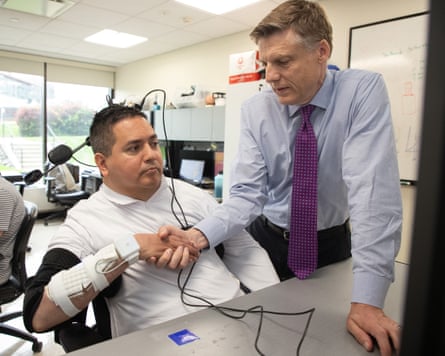
Writing in Nature Medicine, the researchers describe Thomas’s progress after training with the system for 35 weeks. The strength in his right arm increased 86%, while his left was 62% stronger. Having not been able to lift his hands to his face at the start of the trial, he could now independently scratch his nose and wipe his face, researchers said.
The researchers went on to develop a technique called cortical mirroring to improve Thomas’s sense of touch. They recorded his brain activity while he imagined being touched and then stimulated sensory regions of his brain with the same patterns. As they did this, they simultaneously stimulated his skin and spinal cord. After 25 weeks of therapy targeting his right wrist, Thomas regained the sense of touch in a region that had been numb since his accident.
“In a recent follow up, it was found these gains were still present after more than two years,” said Bouton. “This is incredibly encouraging.”
It is unclear how much function and sensation the technology can restore to paralysed limbs, and trials involving more patients are needed to see how well it works for patients with different spinal cord injuries.






 English (US) ·