
 3 hours ago
3
3 hours ago
3
The trip was only supposed to be a Memorial Day weekend girls’ getaway to Myrtle Beach, South Carolina, for Patrice “Foxy” Johnson. But once Johnson and her crew arrived, they inadvertently found themselves in the middle of an annual bike week where several thousand riders had convened. Johnson watched the “backpacks”, or the women who rode on the backs of male motorcyclists’ bikes, and realized she too wanted to be part of the community. She didn’t want to accompany the male riders, though. She wanted to ride herself.
In that moment about 30 years ago, Johnson decided that next time she would be attending bike week and coming with her own set of wheels. Once she returned to her home town of Raleigh, North Carolina, she enrolled in a foundational bike riding class at Johnston community college to learn more about motorcycles. Since then, she’s become such a staple in the Black motorcycle community nationwide that she holds multiple leadership positions across organizations.
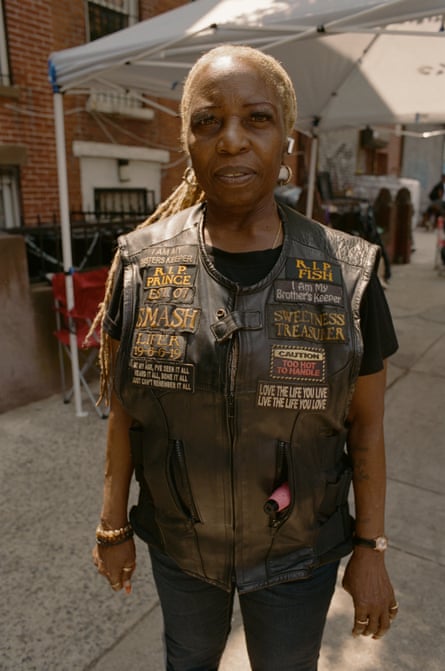
Just about every weekend, particularly in the summer, a Black motorcycle club in some US city is having their annual ride, picnic or other social gathering amid food and music. A place for bike enthusiasts to convene among like-minded community members, some biker clubs date as far back as the 1940s, starting after the second world war. Today’s rides are part of the culture of freedom of movement that started as a response to exclusion from white motorcycle clubs and labor discrimination due to Jim Crow.
History on wheels
One of the clubs where Johnson invests her time is Black Girls Ride (BGR), which has supported women of color in motorsports since its inception in 2011. The group has meetups several times a year in cities such as Houston, Daytona Beach and Los Angeles, it publishes a digital magazine and a podcast, sells its own gear, and has annual traditions such as participating in the Essence festival, a music festival for Black women, every July in New Orleans. About 250 to 300 BGR members typically make the trip to Louisiana. “The police officers will clear the street for us to walk down Bourbon Street with a second line band,” Johnson, the Carolinas ambassador for BGR, which has five national ambassadors and a rider leader, said. “We’re chanting: ‘Black Girls Ride! Black Girls Ride!’ We’re dancing in the street.” Once, as a part of their civic engagement goals, BGR “adopted” the Boys and Girls Club of New Orleans and raised more than $30,000. Such traditions among Black motorsports enthusiasts help engender leisurely fun and community building.
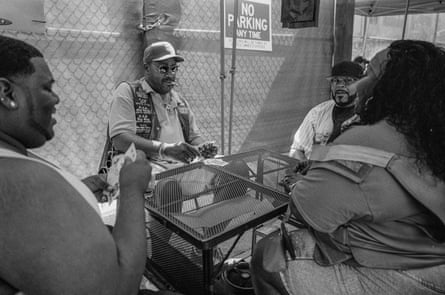
Part of that community building is providing members with education on Black history. The Buffalo Soldiers Motorcycle Club, one of the largest motorcycle clubs in the country with roughly 5,000 members, for instance carries the name of the all-Black military units of the ninth and 10th US cavalry regiments established by Congress in 1866. One of its current club members, the air force veteran Randy Hayward, also known as Detroit Randy, recalled a memorial ride called The Buffalo Thunder from Washington DC to Detroit: “We rode through communities and everybody had their flag out … Black soldiers may not have been celebrated when they came home.”
Annually, the Buffalo Soldiers Motorcycle Club holds a July convention in select cities such as Tampa, Florida; Concord, North Carolina; and Mobile, Alabama, where safety training sessions, rides, cookouts and community outreach are a part of regular programming. “The best way to fellowship is on two wheels,” Hayward said, before listing some of the history-driven rides that his organization has taken to historic sites like Black Wall Street and the Wilberforce, Ohio, home of Col Charles Young, the first Black US army colonel.
Black motorcycle culture is inextricably linked to Black military service. When Black soldiers returned home from the second world war in the 1940s, many were still seeking community with a sense of adventure. Tuskegee Airmen couldn’t get jobs as pilots due to persistent racism, and motorcycling gave them the opportunity to attain a similar thrill – if they could get their hands on a bike. During the war, military motorcycles were vital in scoping out enemy positions and delivering weapons, messages and orders. Once the war ended, the military turned to Jeeps and armored vehicles and therefore military motorcycles flooded the market. Unfortunately, despite these bikes being surplus and cheap, many dealers would not sell motorcycles to Black people.
A former US marine decided to build his own motorcycles. Cliff Vaughs from Los Angeles, California, introduced motorcycle riding as a form of organizing via his work with the Student Nonviolent Coordinating Committee (SNCC) between 1963 and 1964. While visiting working-class Black sharecroppers in Alabama, Vaughs said to the author Paul d’Orléans for his book The Chopper: The Real Story: “I wanted to be a visible example to them; a free Black man on my motorcycle.”
By the late 1960s, bike clubs such as the State Burners of Atlantic City, the East Bay Dragons of Oakland, the Chosen Few of Los Angeles and the Iron Horse Motorcycle Club of Miami, were thriving. The Miami-based organization was founded by Bessie Stringfield, also known as “The Motorcycle Queen of Miami,” who served in the second world war as the only woman in her unit of civilian courier motorcycle dispatchers. She was also the first African American woman to ride across the US solo. On her rides, Stringfield relied on The Negro Motorist Green Book, a travel and survival guide for Black drivers, so that she could remain safe throughout her journeys.
‘An investment in experiences and freedom’
Today, owning a bike is just the starting point for entry into an organization. “Every club has its own set of rules,” said Anthony “Zeke” Settle, the national president of the Black Stallions Motorcycle Club, which was founded in Los Angeles. For Settle’s organization, members have to be 21 years old, own a motorcycle bigger than 600 cubic centimeters – which means a mid-sized engine with a great capacity for speed – complete a three-month probationary period involving mandatory rides, cross four state lines and attend events where prospects can acquaint themselves official members.
Membership comes at a financial cost as well. Settle explained: “A basic, say 600 sports bike motorcycle – that’s at least [$10,000]. That’s a good used one. The top-of-the-line sports bike – Kawasaki – has one that’s $30,000.”
Alvin C Jacobs Jr, a photographer, rider and the author of Chrome, a coffee table book which showcases Black motorcycle culture, spent over $50,000 on his most recent bike. He acknowledges that associated costs have posed challenges in recruiting younger riders: “It’s an expensive hobby and the average millennial is broke,” said Jacobs.
Biking runs through the Jacobs family. Alvin C Jacobs Jr’s father, Alvin Jacobs Sr, co-founded The Brothers Club in Rockford, Illinois, in 1976, where Alvin Jr grew up, “near the Kegels Harley-Davidson (store)”, he said. And Alvin Jr’s son, Hassan Jacobs, is a millennial rider who served in the military for eight years. He’s not a part of a motorcycle club and therefore is not subjected to the financial obligations of an organization, but he is proud to be a younger rider: “I feel like when I’m on the open road, particularly on a bike, I am able to move freely at speeds that don’t constrain me,” Hassan said. “When I’m walking, running or even driving, I feel like I’m held back by the arbitrary limits of my body. And even in a car I don’t get that mind-to-body connection that I get on a bike. It’s almost like having a new body to glide through the road with. Freedom.”
There are some club-affiliated millennials, however, who face the financial hurdles head-on. Shanika “Tru” Beatty, the founder and president of Caramel Curves, an all-Black women motorcycle club, says: “Some of our members finance their bikes, some buy used and others save until they’re ready. One thing that makes Caramel Curves special is that we support each other. We share maintenance tips, and help new riders navigate the process. We want riding to be accessible, not intimidating. At the end of the day, motorcycling isn’t just an expense to us. It’s an investment in experiences, friendships, personal growth and freedom.”
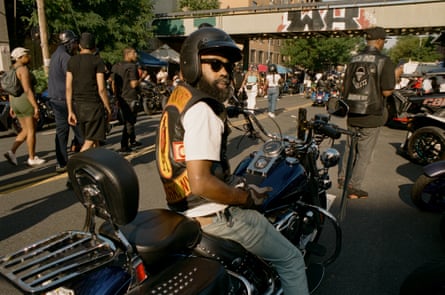
Since its inception in 2005, Caramel Curves has expanded to 31 members across two chapters in New Orleans and Atlanta. During the summer, its most active season, Caramel Curves organizes group rides, attends other bike events, and hosts sessions where members get to know one another on and off their bikes. “We organize group rides, attend bike events and create spaces for our members to connect both on and off the bike,” Beatty said. “It’s also a time when we welcome new riders who are just getting started and want to be part of something supportive and empowering.”
A supportive community is what also inspired Phillip “Dutch” Boyd to join a motorcycle group, after discovering his love for riding during the pandemic: “My friends rode back in the day and they would always crash! I didn’t think bikes were safe until I did some research during the Covid lockdown.” The first day that Boyd learned how to ride a bike from his brother-in-law changed his life. After solo riding for a year, he had the opportunity to squire, or prospect, at The Flaming Knights, a predominately Black motorcycle club founded in 1968. He earned his patches, which delineate club affiliation, and became a member.
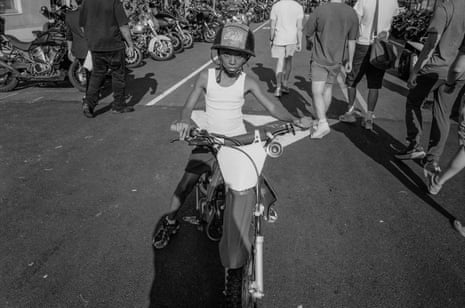
A few weeks ago, the Flaming Knights attended the annual Bike Week in Crown Heights, Brooklyn, a convening of bikers from all over the country. About 200 bikers showed up, mingled with others and shopped the local street vendors. R&B and rap music blasted from nearby speakers, and a few kids played on their mini bikes as the adults relaxed with their coolers or ventured around the corner to the clubhouse of Imperial Bikers, the motorcycle club that hosted the event.
Regardless of how Black bikers discovered their love for the sport, biking is less of a hobby and more of a lifestyle. “One of the biggest misconceptions is that Black motorcycle culture is only about clubs, leather and looking tough,” said Beatty of Caramel Curves. “In reality, it’s about community, family, freedom and giving back.”




 English (US) ·
