
 1 hour ago
3
1 hour ago
3
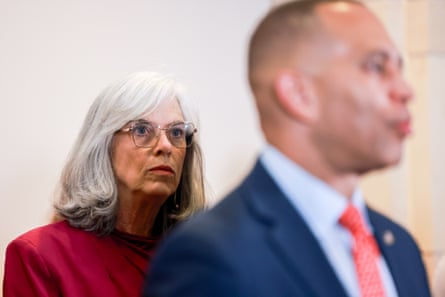
Somewhere in the days before Wednesday’s vote, Hakeem Jeffries, the House minority leader, sat down and wrote his caucus a letter urging Democrats to reject an amendment that would strip security assistance to Israel. For most of his tenure as Democratic leader, that kind of internal whipping operation would have been unnecessary, because the outcome would have been assumed.
His own second-in-command voted the other way anyway.
Katherine Clark, the House minority whip, broke publicly with the position Jeffries had spent days defending. The significance isn’t that one senior Democrat defected, but instead that the party’s chief consensus builder, and more than 100 other Democrats, broke ranks on one of Washington’s (and America’s) most defining and confounding policy questions, and one that exposes a caucus divide that can no longer be managed behind closed doors.
The amendment itself, offered by the Kentucky Republican Thomas Massie who just lost his re-election bid after a flood of pro-Israel lobby support boosted his rival, would have eliminated $3.3bn in security assistance to Israel from the state department appropriations bill. As expected, it failed, 314-104.
But 103 House Democrats – nearly half the caucus – voted for it. Nancy Pelosi, one of Congress’s longest-serving defenders of the US-Israel relationship, joined them, later calling the amendment “ill-conceived” while saying she supported it “for the message that it sends”. The amendment, which was never going to become law, instead became something more revealing: a roll call measuring how much of the traditional bipartisan consensus on Israel still commands automatic loyalty.
Republican leaders made Massie’s amendment eligible for floor consideration, a cynical move that could be seen as an attempt to force politically uncomfortable votes for Democrats ahead of the midterms. The strategy produced an awkward consequence for Republicans as well.
Along with about half of all Democrats, every GOP member except Massie is again on record supporting continued and unrestricted military assistance to Israel, a state accused of genocide in Gaza by the highest international human rights office in the world, as settlers harass local Palestinians and land-grab in the occupied West Bank, and as the military seizes land in southern Lebanon and looks at Turkey, a Nato member, as its next strategic threat.
This all comes at a moment when public opinion on unconditional aid has shifted markedly, with the Institute for Global Affairs finding that only 16% of US adults think unrestricted aid to Israel should continue, dropping to 9% when considering adults under 30 from both parties.
Nor is Massie entirely isolated inside his own party. Earlier this week, JD Vance spent hours on Joe Rogan’s podcast accusing unnamed figures “within Israel’s system” of working to undermine his diplomacy with Iran and condemning Americans who, in his view, participated in that effort. A growing willingness among prominent Republicans to criticize Israeli influence over US foreign policy would have been politically extraordinary only a few years ago.
Still this is not entirely a new debate: in April 2024, while under Joe Biden, dozens of lawyers inside and outside the administration then called on the president to immediately halt military aid to Israel after contending the state had probably violated US law and the Geneva conventions with disproportionate attacks on civilian populations.
The more consequential battle now, however, lies ahead. Buried inside this year’s National Defense Authorization Act is the US-Israel Defense Technology Cooperation Initiative, legislation that would significantly deepen defense-industrial integration between the two countries by expanding joint research, testing and procurement arrangements beyond existing cooperation. Bernie Sanders has warned that it would move the two defense establishments toward an unprecedented level of integration with comparatively little congressional scrutiny. Massie and Congressman Ro Khanna have already tried once to remove the provision but were blocked in the House rules committee before it reached the floor.
The two debates point toward the same political reality: while the bipartisan majority has not disappeared, and Congress still overwhelmingly supports military assistance to Israel, what has changed is that maintaining it now requires active political management from leaders whose own deputies increasingly disagree with them.
This year’s Democratic primaries have already elevated a cohort of candidates who ran explicitly against the old consensus and won: progressives and democratic socialists in New York, New Jersey, Colorado, Pennsylvania and Illinois who campaigned on cutting aid and calling Aipac money toxic, and a marquee Michigan Senate primary, where candidate Haley Stevens voted alongside all Republicans to keep the aid flowing.
Those other candidates, who won in solidly Democratic districts, represent their voters and head to Washington in January with mandates built on rejecting the position Jeffries is still defending and the one Vance is still, however awkwardly, trying to hold together for his own coalition.
Wednesday’s vote may or may not be brushed aside in the coming news cycles. But the pattern it revealed won’t be: a bipartisan floor that has held for 50 years is buckling from both directions at once.







 English (US) ·